The Object at the Edge of Everything
How still life — the most domestic of genres — became the most radical battleground of twentieth-century art.
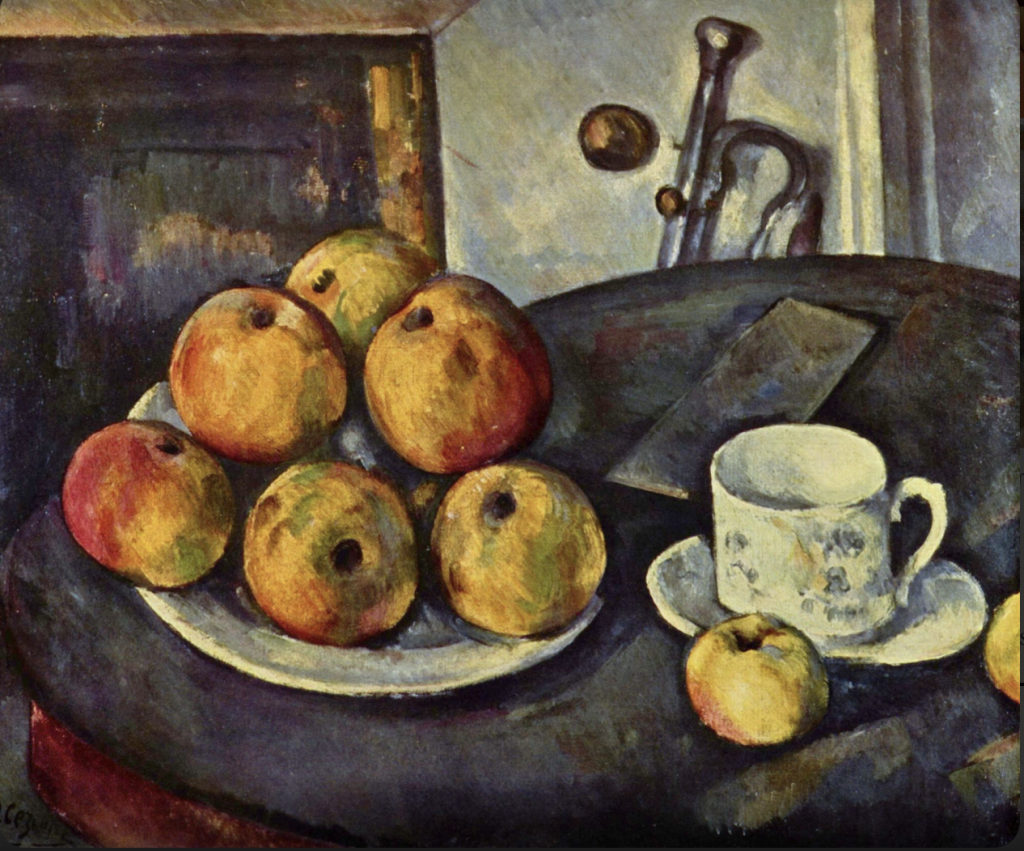
There is something deceptively humble about a bowl of fruit. A vase of wilting flowers. A loaf of bread beside an overturned wine glass. For centuries, still life occupied the lowest rung of the academic hierarchy — beneath history painting, portraiture, even landscape. And yet, when the twentieth century dawned, it was the still life that artists seized upon first, fiercest, most recklessly. In the bowl of apples, they found a universe.
The reasons are not hard to understand. The genre offered everything an avant-garde needed: complete freedom of arrangement, no narrative obligation, no patron demanding a recognisable face. The objects on the table could be assembled, disassembled, flattened, fractured, or dissolved. They could be painted with the luminous solidity of Old Masters or scraped to near-nothing with a palette knife. They asked only one question of the artist, and it was the only question that mattered: how do you see?
The Inheritance of Cézanne
The twentieth century’s obsession with still life begins not quite within it, but at its threshold. Paul Cézanne, working in Provence through the 1890s in increasing isolation, had quietly dismantled the rules of pictorial representation. His apples are not seductive; they are geological. They sit on tilted tables with the mute authority of mountain ranges. Multiple viewpoints collapse into a single image. The world refuses to be seen from one place at one time — and Cézanne refuses to pretend otherwise.
When Cézanne died in 1906, a memorial exhibition the following year sent shockwaves through Paris. Two young Spaniard and Frenchman — Pablo Picasso and Georges Braque — absorbed those lessons with extraordinary intensity and velocity. Within three years, they had taken Cézanne’s tilted planes to their logical — or rather, illogical — conclusion.
The Cubist Rupture
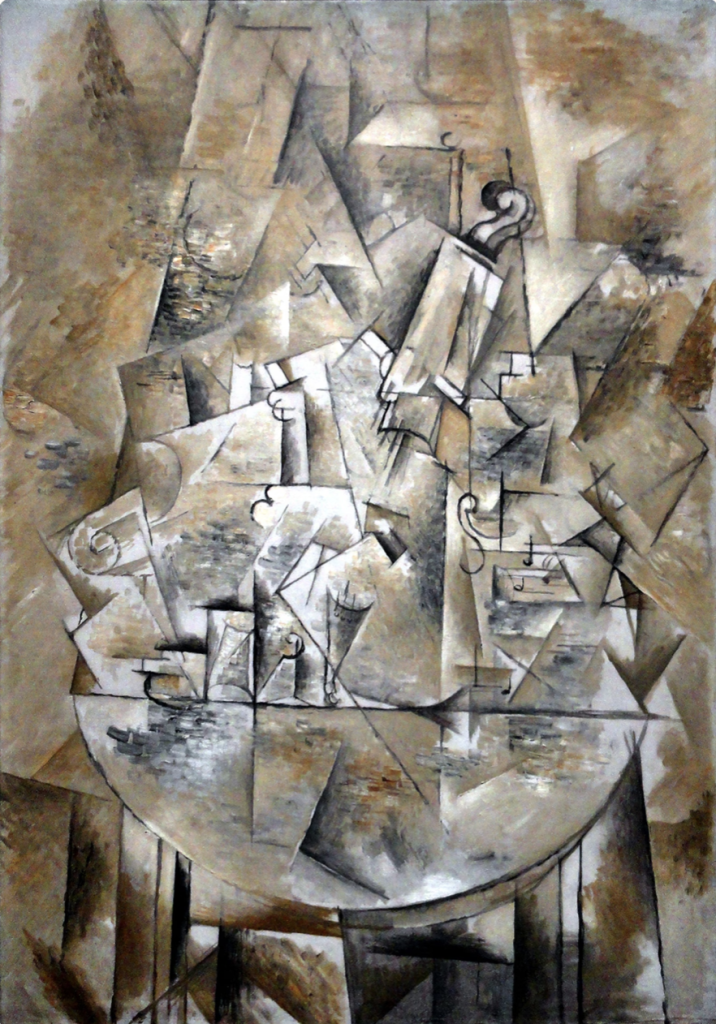
Analytical Cubism — the radical phase Picasso and Braque developed together between roughly 1908 and 1912 — found its most fertile ground in the still life. Guitars, bottles, newspapers, playing cards: the objects were ordinary, chosen almost arbitrarily. What was extraordinary was what was done to them. Surfaces fractured into interlocking grey and ochre planes. The distinction between object and surrounding space collapsed. A violin could be read simultaneously from front, side, and above. The picture plane — that invisible window the Renaissance had installed between viewer and world — was shattered.
The collages that followed were equally revolutionary: Braque’s introduction of commercial wallpaper, newspaper cuttings, and wood-grain paper into his canvases in 1912 brought the literal world of things directly onto the surface. The still life had always been about objects; now it was physically made of them. Representation and reality began to blur in ways that painting has not fully recovered from — nor wanted to
Surrealism and the Uncanny Object
If Cubism interrogated how objects are seen, Surrealism interrogated what they mean — and what menace they conceal. Salvador Dalí’s drooping watches in The Persistence of Memory (1931) are technically a variant of still life: objects on a surface, unmoving. But they pulsate with anxiety. Time itself has become a soft, rotting thing. Giorgio de Chirico, an earlier influence on the Surrealists, populated his paintings with architectural objects and strange juxtapositions — artichokes, gloves, classical busts — that achieve their power precisely through the deadness of their arrangement.
René Magritte took the domestic object and made it a philosophical weapon. His apples — swollen, green, room-filling — are not Cézanne’s geological facts. They are paradoxes. They fill the space they cannot fit. They wear bowler hats. The object is no longer innocent, if it ever was.
1907 – Cézanne retrospective in Paris ignites a generation. Picasso paints Les Demoiselles d’Avignon the same year, its fractured planes partly indebted to Cézannian still life.
1912 – Braque introduces papier collé into still life, merging real materials with representation. Cubist collage is born.
1931 – Dalí’s Persistence of Memory reimagines the tabletop as dreamscape. Surrealism transforms the still life into psychological theatre.
1953 – Giorgio Morandi, the great Italian recluse, is awarded the Grand Prize for painting at the São Paulo Biennial — recognition for decades of near-monastic devotion to bottles and jars.
1962 – Andy Warhol exhibits Campbell’s Soup Cans at Ferus Gallery, Los Angeles. The consumer object enters art history permanently.
1970″s – Photorealist painters including Ralph Goings and Audrey Flack revive the still life with hyperreal precision, confronting painting with photography’s challenge.
Morandi’s Silence
Against all this noise and rupture, one painter maintained an extraordinary quietness. Giorgio Morandi, working in Bologna across more than five decades, painted the same small congregation of bottles, jars, and boxes again and again and again. He owned the objects. He painted them. He stored them on shelves in his studio, coated in dust he would not allow anyone to disturb. He returned to them daily, as one returns to prayer.
What Morandi achieved in this repetition is among the most remarkable things in twentieth-century art. His objects, stripped of identity through familiarity, become pure presences. The space between them is as weighted as the forms themselves. The colour — those extraordinary chalky pinks, greys, and ochres — seems to emanate from inside the objects rather than fall upon them from without. Morandi proved that still life could be an entire artistic universe, inexhaustible, requiring nothing beyond a few dusty bottles and an unwavering attention.
Warhol and the Consumer Object
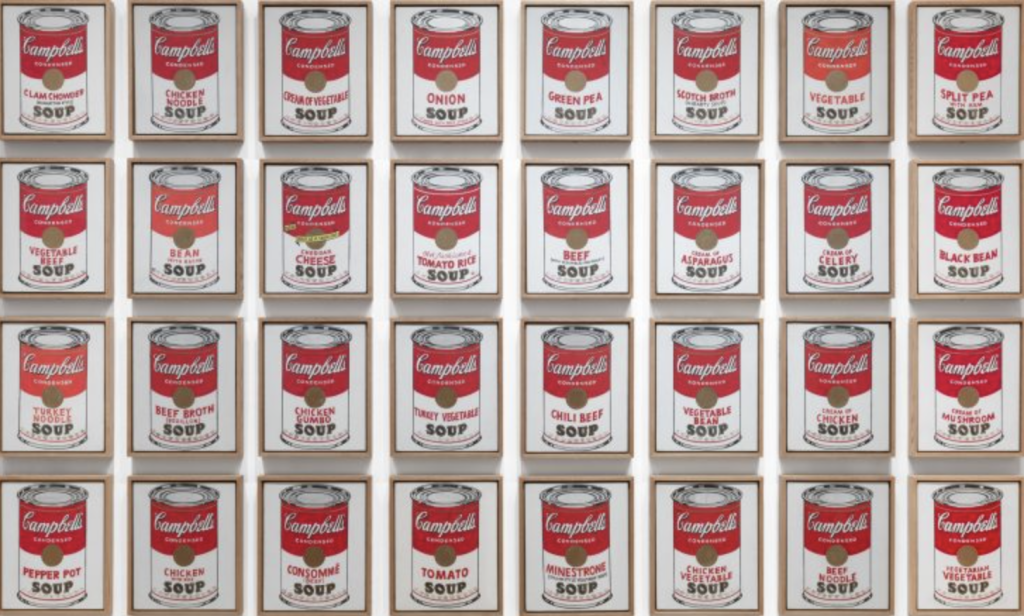
Museum of Modern Art, New York. Thirty-two canvases, one for each variety. The supermarket shelf enters the gallery; still life absorbs mass culture.
If Morandi found the infinite within the intimate, Andy Warhol found a different infinity in the supermarket aisle. His Campbell’s Soup Cans, first exhibited in Los Angeles in 1962, were a provocation so blunt it took time to understand their depth. Here was still life stripped of any handmade aura, reproduced with silkscreen efficiency, celebrating not the artist’s relationship with objects but capitalism’s. The tin can — mass-produced, interchangeable, designed for disposal — was accorded the same ceremonial presentation as a Flemish silver goblet.
This was not mere irony, or not irony alone. Warhol understood that the consumer object was the still life of modernity: the thing most handled, most desired, most central to daily life. To paint it was to paint the world as it actually was. The question of whether this constituted celebration or critique has never been definitively answered, and that ambiguity is precisely what has kept it alive.
The Long Afternoon
By the century’s final decades, still life had become something too large and too dispersed for easy definition. Photorealists like Ralph Goings and Audrey Flack used it to challenge the boundaries between painting and photography, rendering chrome diners and cosmetics cases with a cool, hyperreal exactitude. Flack’s vanitas paintings — skulls among lipsticks, candles beside photographs — returned the genre to its Baroque roots with feminist force, asking again what it means that women’s objects are objects.
Meanwhile, in Germany and Britain, painters like Gerhard Richter continued the conversation between figuration and abstraction that still life had always hosted. Richter’s photo-paintings of candles smear the familiar image into something on the edge of dissolution — neither photograph nor painting, neither present nor absent, the object perpetually slipping away.
What the twentieth century demonstrated, across all its upheaval, is that still life endures because the question it poses cannot be exhausted. Every generation must learn again to look at the things around it — the bottle, the apple, the tin can — and ask: what is this? What does it mean to render it? What is lost, and what is discovered, in the act of translation from world to canvas? These are not questions that can ever be finally answered. That is why the genre survives, why it thrives, and why the greatest painters will always, eventually, return to the table.
All artworks discussed are held in major public collections. Cézanne’s Still Life with Apples (1894) is at the Museum of Modern Art, New York. Braque’s Le Guéridon (1911) is at the Centre Pompidou, Paris. Warhol’s Campbell’s Soup Cans (1962) is at the Museum of Modern Art, New York.