The Gilded Void: On Kitsch, Its Seductions, and the Con of Manufactured Depth
There is a balloon dog the size of a small car, forged in mirror-polished stainless steel, reflecting the crowd that gathered to admire it. It costs somewhere north of $50 million. The crowd, educated and sophisticated, loves it without embarrassment, which is precisely what its maker intended. Jeff Koons has never hidden what he is doing. The problem is that much of the art world has pretended, for decades now, that what he is doing is something else entirely.

This is the central deception of contemporary kitsch: not that it is pleasurable, but that pleasure has been dressed in the borrowed clothes of criticality and passed off as intellectual seriousness. To understand why this matters, we first need to understand what kitsch actually is, why we are so helplessly drawn to it, and what is lost when an entire cultural apparatus conspires to pretend it is something more.
What Kitsch Is
The word itself comes from nineteenth-century Munich, likely derived from the German verkitschen, meaning to make cheap, to flog off. From the beginning, kitsch was understood as a category of the counterfeit: objects and images that mimic the emotional registers of genuine art without doing any of the genuine work. Clement Greenberg, writing in 1939, defined kitsch as “the epitome of all that is spurious in the life of our times.” Milan Kundera, more poetically, described it as “the absolute denial of shit” — by which he meant the denial of everything difficult, ambiguous, contradictory, or morally uncomfortable about human existence.
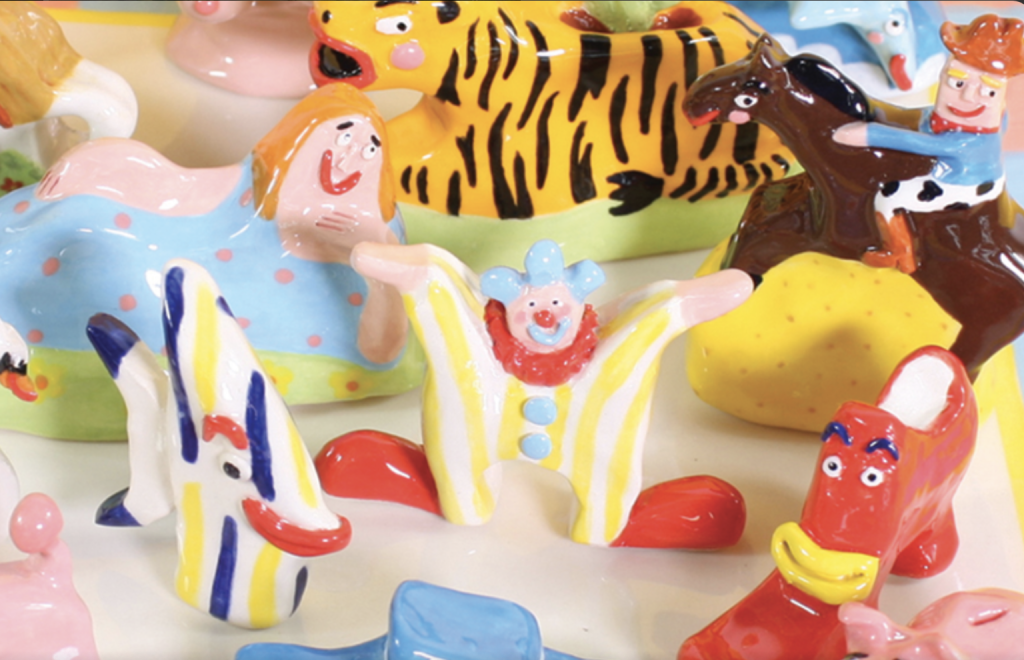
Kitsch operates through a particular mechanism: it delivers the sensation of an emotion without requiring the experience that earns it. A saccharine painting of a child gazing at a sunset does not ask you to have ever genuinely contemplated mortality or innocence; it simply triggers the neurological response associated with those contemplations. It is emotional fast food, immediately satisfying, nutritionally hollow. Kitsch is engineered to please. It avoids difficulty, ambiguity, and the demands that serious art makes upon its audience. It flatters rather than challenges. It confirms rather than disrupts.
The Koons Problem
Jeff Koons began his career with genuine conceptual wit. His early “Equilibrium” tanks — basketballs suspended in distilled water — had a real strangeness to them, a meditation on aspiration and stasis that rewarded attention. But somewhere in the mid-1980s, Koons discovered something more lucrative than wit: the wholesale embrace of kitsch as an aesthetic, sold to collectors and institutions as postmodern irony.
The “Banality” series of 1988, which included porcelain sculptures of Michael Jackson with his pet chimpanzee Bubbles and a wooden Bear and Policeman straight from a souvenir shop, announced the strategy plainly. Koons was, he claimed, celebrating popular culture without condescension, elevating the vernacular, collapsing the hierarchy between high and low. This was the critical alibi. The work itself is simpler: A modest, recognisable visual language of sentimentality, reproduced at enormous scale and ferocious technical expense.
The “Celebration” series — the balloon animals, the party hats, the enormous floral Puppy installed outside the Guggenheim Bilbao — consolidated this formula. The objects are undeniably spectacular. The craftsmanship is extraordinary. The surfaces achieve a perfection of finish that no actual balloon or flower could sustain. And therein lies the trap: the spectacle of technical mastery is recruited to do the work that conceptual depth is supposed to do. We are awed by the how and encouraged to mistake that awe for an engagement with a what.
Koons himself is a masterful rhetorician of apparent profundity. “I’m trying to use art as a tool of communication,” he has said, “to affirm people’s interests and their own history.” Every piece, in his telling, is about “acceptance” and “trust” and the viewer’s relationship to their own desires. These are not untrue statements, exactly — they are the statements one makes about any pleasurable object. A good hamburger affirms your interest in food and your history of hunger. This is not the same as saying something about the human condition.
What Koons offers is a perfected version of the mirror: you look at the balloon dog’s polished surface and see your own distorted reflection gazing back. The art community’s willingness to frame this as profound self-reflexivity rather than simple narcissism is one of the more remarkable acts of collective rationalisation in recent cultural history.
Hirst and the Theatre of Mortality
Damien Hirst presents a more complicated case, and in some ways a more interesting one, precisely because his early work genuinely earned its reputation for seriousness. The Physical Impossibility of Death in the Mind of Someone Living— the tiger shark preserved in formaldehyde — was, when it appeared in 1991, genuinely arresting. The shark was real. Death was real. The glass tank transformed a fact of nature into something between a scientific specimen and a sacred relic. There was a genuine conceptual tension in the work: the animal was both present and absent, preserved and destroyed, comprehensible and alien.
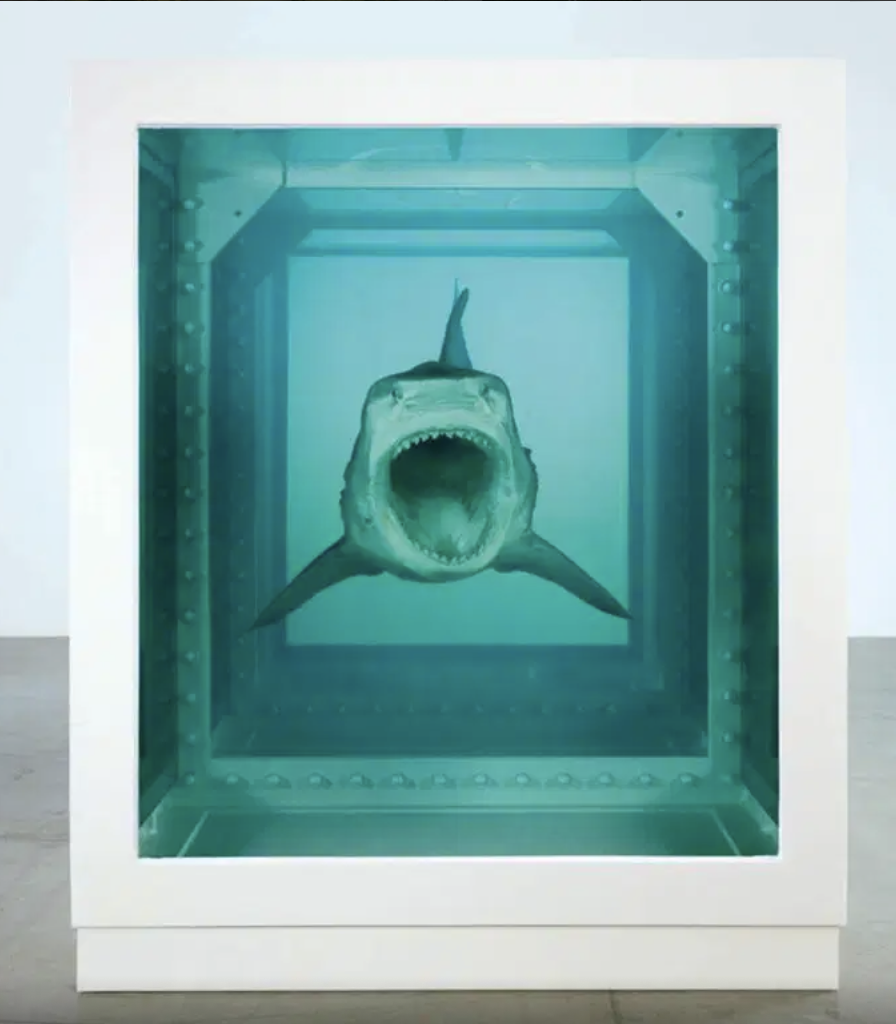
But Hirst discovered, like Koons before him, that the idea of confronting death sells better than the confrontation itself. The spin paintings — canvases created by dripping paint onto a rotating surface, generating circular patterns that are decorative. The spot paintings, produced in their thousands by studio assistants, are among the most aesthetically undemanding works ever successfully presented as fine art: coloured dots on white backgrounds, pleasant in the way that a good set of curtain fabric is pleasant.
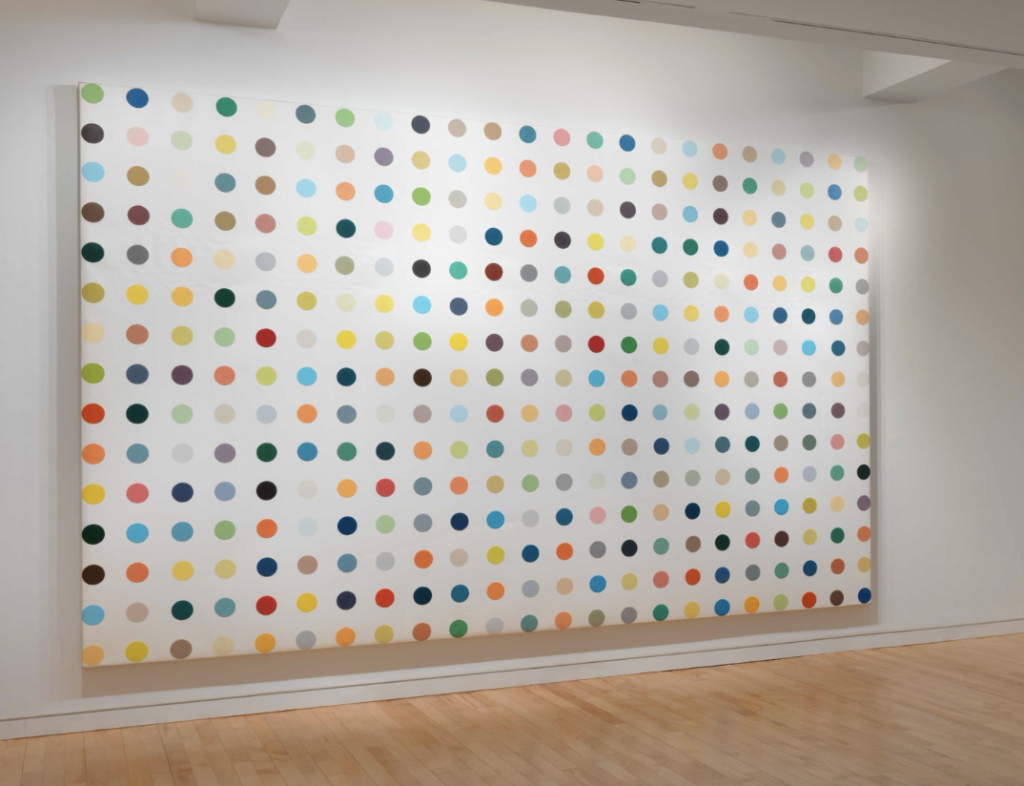
What Hirst did with these works was to import the moral seriousness of his better pieces into the reading of his lesser ones. Once you have made The Physical Impossibility of Death in the Mind of Someone Living, a spot painting is not just a spot painting — it is, retrospectively, a Hirst. The brand does the intellectual work that the object cannot. The skull encrusted with 8,601 diamonds — For the Love of God, 2007, asking price £50 million — is perhaps the most naked expression of this logic: a memento mori so encrusted with luxury that the memento and the mori cancel each other out completely. What remains is pure spectacle, pure kitsch, and a price tag that is itself the message.
This is Hirst’s genuine artistic contribution, demonstrated with absolute clarity that contemporary art’s market and its critical apparatus had become so thoroughly entangled that neither could any longer see the other honestly. The price of the diamonds in the work is the meaning. The rest is atmosphere, or to some, meaningless, nothingness.
Why We Love Kitsch
None of this is to say that the pleasure kitsch provides is false, or shameful, or beneath us. The impulse toward kitsch is deeply human, and understanding it honestly is more useful than condemning it.
Kitsch provides immediate emotional legibility. In a world of genuine complexity, where moral questions resist resolution and beauty often arrives entangled with darkness, the clean emotional signal of kitsch is genuinely restful. The balloon dog doesn’t pull your thoughts, does not ask anything of you. It simply gleams. Kitsch is often communal. The ornaments people keep on their mantlepieces, the sentimental paintings passed between generations, the cheap ceramic figurines that tourists carry home — these objects have a meaning not from any intrinsic artistic quality but from the web of associations and relationships surrounding them. This is not kitsch as cultural failure; it is kitsch as human need, and it is largely benign.
There is, moreover, something genuinely pleasurable about scale, spectacle, and virtuosity — the things that Koons’s balloon animals provide in abundance. The desire to see something perfectly made, something that exists at the limit of what materials and craft can achieve, is not a lesser desire than the desire for conceptual rigour. We need not pretend it is.
The problem is not the pleasure. The problem is the lie.
The Danger of the Alibi
When kitsch presents itself as kitsch — when the souvenir shop sells its snow globes without claiming they are meditations on memory and impermanence — it causes no harm. It is when kitsch acquires an intellectual alibi, when it dresses itself in the language of criticality and profundity, that it begins to corrode something important.
The first casualty is honest conversation about art. When an institution as the Tate Modern or the Guggenheim presents Koons’s balloon animals as serious contemporary art requiring serious critical engagement, it creates a context in which disagreement becomes difficult. To say that the work is not very interesting conceptually is to risk appearing unsophisticated, to seem like someone who “doesn’t get it.” The emperor’s new clothes problem is at its most acute precisely where the emperor is wearing the most expensive tailoring: the exorbitant price of the work becomes evidence of its profundity, and to question the profundity is implicitly to question the wisdom of everyone who paid the price.
The second casualty is artists who are doing genuinely difficult work. The finite attention of critics, curators, collectors, and audiences is not infinite. Every column inch devoted to reassessing the philosophical implications of a spot painting is a column inch not spent on work that actually demands reassessment. Every acquisition budget spent on a Hirst diamond skull is an acquisition not available for something that challenges rather than flatters. Kitsch, promoted to the status of serious art, does not merely take up space; it displaces, it contaminates.
The third casualty is the audience’s own capacity for genuine aesthetic experience. Kitsch, like any fast food, recalibrates appetite. If what we train ourselves to enjoy is the immediate gratification of spectacle, colour, and finish, we become progressively less capable of tolerating the effort that serious art requires, resisting interpretation, and allowing a work to make demands. A culture saturated in high-end kitsch is a culture that has made itself comfortable with a stunted form of looking.
The Critical Complicity
It is worth asking why the critical establishment went along with it. The answer is not simple vanity, though vanity plays a role. Part of the explanation lies in the genuine theoretical frameworks of the 1980s and 1990s — postmodernism’s attack on hierarchies, the rehabilitation of popular culture, the suspicion of “good taste” as a mechanism of class exclusion — which provided legitimate intellectual cover for exactly the kind of category collapse that Koons and Hirst exploited. If there is no principled distinction between high and low culture, then a balloon dog and a Brancusi are available for the same consideration. This is true as far as it goes. What it does not mean is that they are equally interesting.
The market’s role in critical judgement is harder to extricate from the critical judgement itself. When a work sells for fifty million dollars, every institution that owns one has a powerful incentive to ensure that the critical narrative supports its value. Scholarship, exhibition catalogues, critical essays, retrospectives — all of these function partly as price maintenance. The art world’s critical and commercial apparatuses are not independent systems reaching the same conclusions; they are a single system with interlocking interests. This is not a conspiracy; it is an ecology.
So, now what?
None of this requires us to pretend that pleasure is not real, that spectacle has no value, or that popular sensibility is inherently inferior to cultivated taste. Koons’s balloon animals are genuinely enjoyable objects. The diamond skull is genuinely dazzling. Hirst’s early animal works are genuine achievements. The pleasure is real. The craft is real.
What is not real — what has been, largely, a sustained and lucrative fiction — is the claim that these objects make serious demands on our thinking, that they participate in the long conversation about what it means to be alive and conscious and mortal and together. They do not. They reflect that conversation back at us, flatteringly, through a polished stainless steel surface. We see ourselves in them, and we look rather good. This is the gift of kitsch.
But it is not art’s deepest gift. Art’s deepest gift is the gift of genuine difficulty: the thing that does not reflect you back at yourself but that confronts you with something genuinely other, that requires something of you and, in requiring it, changes you. That gift is rarer, less comfortable, less immediately gratifying, and less lucrative. It does not sell for fifty million dollars at Sotheby’s. It is what we are here for, nonetheless.
The writer’s views are their own. This article does not constitute financial or investment advice regarding the art market.