Possessed By Color
He kept a diary for twenty years. A running conversation with himself about what it meant to make something, to see something, to be a person in a world that kept threatening to become unrecognizable. Reading Paul Klee’s diaries is one of the stranger pleasures available to anyone interested in how a great artist actually thinks: wry, self-doubting, suddenly exalted, then sardonic again. He was a violinist before he was a painter. He was, arguably, a poet before he was either. That multiplicity is everywhere in his paintings.
Klee was born in 1879 near Bern, the son of a German music teacher and a Swiss singer. His childhood was saturated with sound. As a young man he was good enough on the violin to be invited to play with the Bern Municipal Orchestra, and music never entirely left his practice it is in the way his compositions seem to breathe in time. But he turned to visual art, and for years he struggled, making meticulous etchings and drawings in black and white while secretly unsure whether colour would ever come to him. He later wrote that he thought of himself as a draftsman first, someone for whom color remained a foreign country.
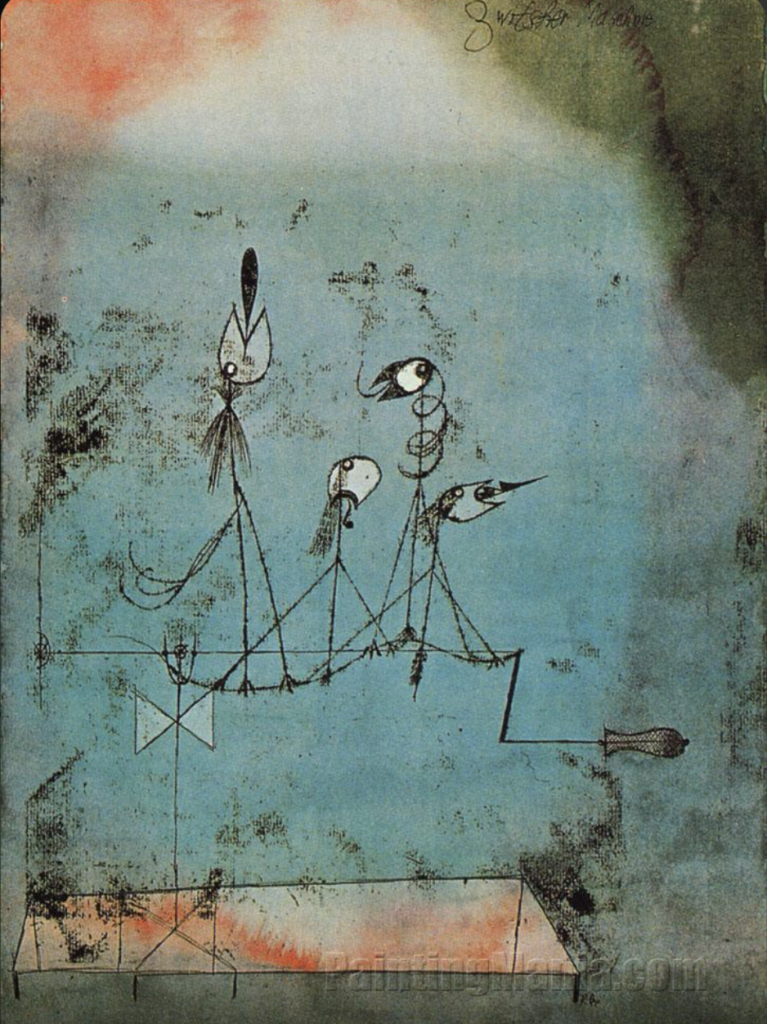
Twittering Machine (Die Zwitscher-Maschine), 1922. Oil transfer drawing and watercolor on paper. Museum of Modern Art, New York. One of Klee’s most celebrated works — part satire, part nightmare, part musical joke.
Then came Tunisia. In April 1914, Klee traveled to North Africa with two painter friends, August Macke and Louis Moilliet. The trip lasted two weeks. What happened to him there is one of the more extraordinary documented moments of artistic transformation in the 20th century — not because we have to infer it from the paintings, but because Klee wrote it in his diary, words that have since become among the most quoted in the history of art.
“Color possesses me. I don’t have to pursue it. It will possess me always, I know it. That is the meaning of this happy hour: color and I are one. I am a painter.”
He wrote this on April 16, 1914, sitting in Kairouan. He had been walking through the city, painting watercolors of walls and minarets, dazzled by the quality of North African light — the way it did not merely illuminate but seemed to saturate everything it touched, dissolving the boundary between colour and form. Before Tunisia, Klee had worked mostly in monochrome. After it, his palette opened like a door. The watercolors he made during and immediately after the trip — transparent planes of warm ochre, dusty pink, mosaic blue — mark a decisive before-and-after in his practice.
There is something almost comic in the precision of that moment: thirty-four years old, in a Tunisian city, and suddenly understanding, with complete certainty, that he was a painter. Most artists spend entire careers circling that knowledge. Klee found it in a fortnight, in a foreign country, under a different sun. Three months after he returned home, the First World War began.
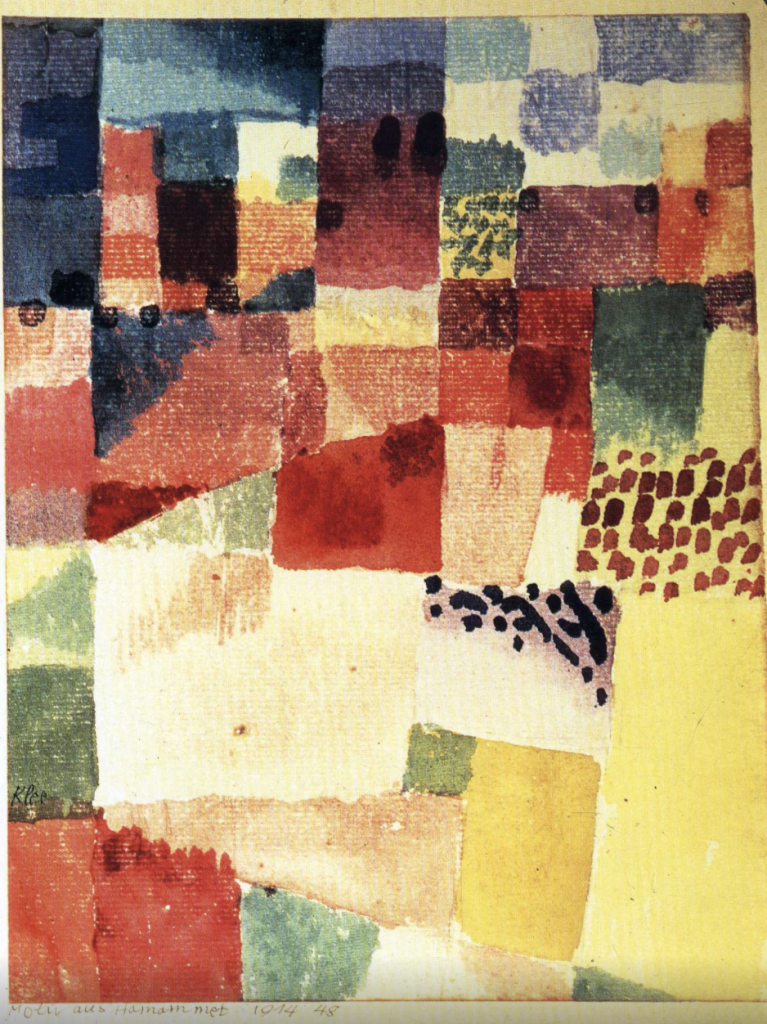
Hammamet with Its Mosque, 1914. Watercolor and pencil on paper. The Metropolitan Museum of Art. Made during the Tunisia trip that Klee described as the moment color “possessed” him.
In 1920, Walter Gropius invited Klee to join the faculty of the Bauhaus in Weimar. He accepted, and spent the next decade teaching alongside Wassily Kandinsky, Oskar Schlemmer, and László Moholy-Nagy in what was, for a brief window, the most concentrated gathering of modernist talent in Europe. Klee taught the preliminary course and later the weaving workshop — an odd assignment for a painter, but one that suited his instinct for systematic thinking about form. He produced two extended bodies of writing during these years, the Pedagogical Sketchbook and his lectures compiled as the Notebooks, which remain essential reading for anyone trying to understand how a visual intelligence of this calibre actually processes the world.
His Bauhaus paintings are among his most refined: small, jewel-like works in which geometric structure and lyrical colour hold each other in a kind of productive tension. He was prolific to an almost incomprehensible degree — nearly half of his total output of 10,000 works was made during his Bauhaus decade. He painted on linen, burlap, muslin, gauze, cardboard, and newspaper. He invented transfer techniques, scraped paint through stencils, built up surfaces with chalk and gesso until they resembled manuscript pages or archaeological fragments. The work is endlessly inventive without ever feeling effortful — as though he woke each morning with twenty ideas and spent the day deciding which ones not to pursue.
Critics have always struggled with Klee because he refuses the categories available to them. He was too whimsical for the Expressionists, too lyrical for the Constructivists, too rational for the Surrealists — though all three movements claimed him at various points. He was interested in children’s drawings not as a source of naivety but as evidence that seeing clearly and drawing literally are two entirely different skills, and that adult technical training tends to damage the first while perfecting the second. His “childlike” marks were the product of considerable sophistication: the simplest possible notation for the most complex possible perception.
He was also, in a quiet but systematic way, one of the great color theorists. He studied Goethe’s color theory, followed the Delaunay-inflected chromatic Cubism that Macke had been developing, and built his own understanding of how colors interact — not decoratively, but structurally and emotionally. For Klee, a color was not a property of a surface. It was a force, a temperature, a note in a chord. His grids of colored squares — developed throughout the 1920s — look deceptively simple. They are in fact precise exercises in how adjacent hues create movement, depth, and mood without recourse to perspective or representation at all.
The last years of Klee’s life are among the most remarkable in the history of modern art. In 1933, Hitler became Chancellor of Germany. The Gestapo searched Klee’s house in Düsseldorf. He was dismissed from his teaching post, branded — falsely — as a Jew, and denounced as a purveyor of “insane childish scrawling.” He left Germany for Switzerland, returning to Bern, the city of his childhood, now effectively an exile in his own birthplace. In 1937, his work was included in the Nazis’ Entartete Kunst — Degenerate Art — exhibition in Munich, alongside Chagall, Kandinsky, Mondrian, and Ernst.
And then, as if in direct reply, he painted Revolution of the Viaducts — arches breaking ranks, marching away from the structure that was meant to contain them. It is one of the great acts of artistic defiance in the 20th century: quiet, deadpan, and utterly devastating.
Around this time he was diagnosed with scleroderma, a progressive autoimmune disease that hardens the skin and gradually restricts movement. His hands, the hands he had used for six decades to draw, began to stiffen. He adapted. The lines in his late work became broader, crayon-thick, almost brutalist in their simplicity — not because he had lost control, but because he was finding ways to work with what remained. His output, which had slowed in the early years of illness, surged again: he made over 1,200 works in 1939 alone, the year before he died. He was, by any measure, accelerating toward the end.
His final works — Death and Fire, the angel series, the last still life — are unlike anything else in his output. The skull in Death and Fire is formed from the letters T, O, D — the German word for death — rendered as features of a face, as if language and image had finally collapsed into each other. He had applied for Swiss citizenship, believing he was entitled to it through his Swiss mother. The application was granted six days after he died, on June 29, 1940.
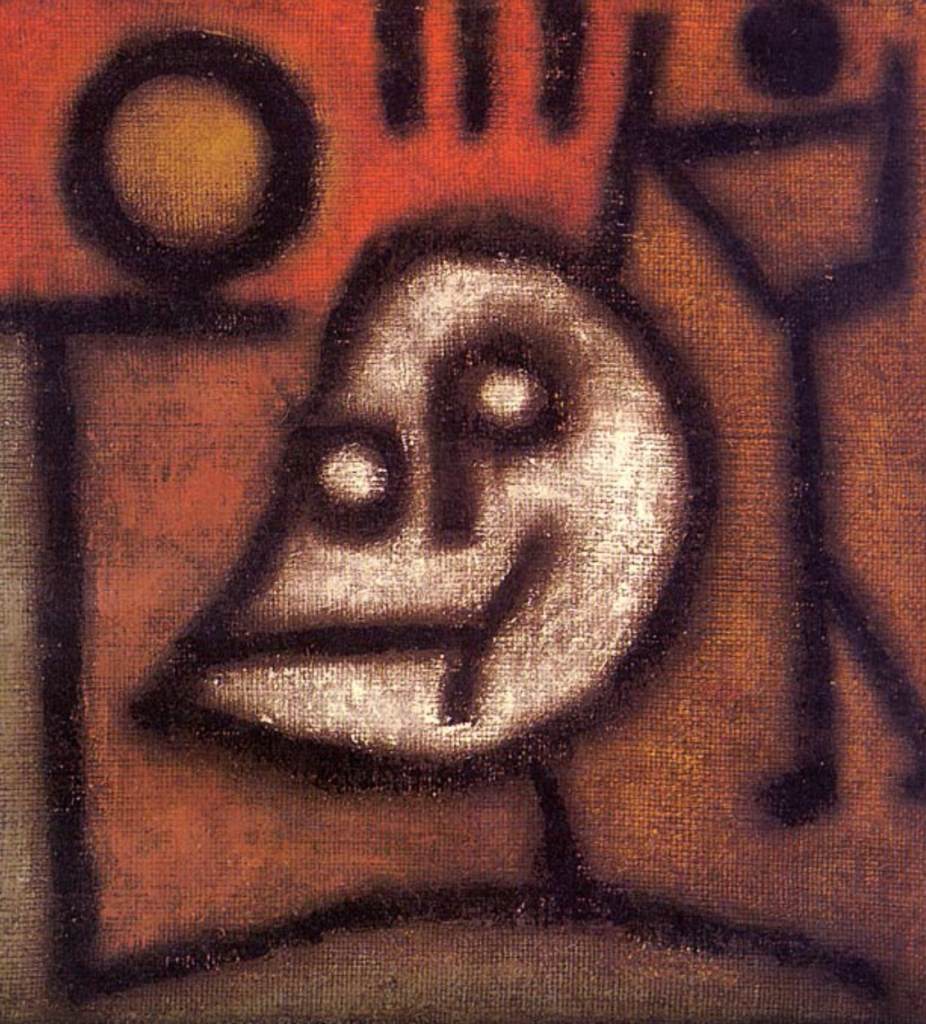
Death and Fire, 1940
“Art does not reproduce the visible; rather, it makes visible.” That sentence, from Klee’s Credo of the Creative, is probably the most concise statement of what serious abstract art is actually attempting. It is not a retreat from the world. It is an argument that the world contains more than the eye, in its ordinary habits, is able to see — and that the painter’s task is to expand the terms of visibility. Klee spent sixty years making that argument, in watercolor and oil and chalk and transfer technique, on burlap and newsprint and gauze, in works so various and so personal that no single one fully represents him.
He remains, more than eighty years after his death, one of the most visited and least fully understood artists of the 20th century. His name is everywhere. His work is in every major museum. And yet there is something about the experience of standing in front of an actual Klee — small, delicate, often no bigger than a notebook page — that no reproduction quite prepares you for. They are more intimate than they look in photographs. More serious. More funny. More strange. They hold your attention the way a very good sentence does: you think you have understood them, and then you realize you are still reading.
.>>> Back to articles