Painting the Nation: The Rise of Nationalism in Art
From the sublime landscapes of the Romantic era to the contested monuments of the present, how artists have constructed, weaponised, and dismantled the idea of national identity. A four part article : ( 1. Romanticism and the Birth of National Art, 2. Monuments, Memory, and the Making of National Myth, 3. The State as Muse: Art Under Totalitarianism, 4. Postcolonial and Contemporary Resistance. )
Part 1 Romanticism and the Birth of National Art
Before nationalism could march into the street and build its monuments, it first had to be dreamed. That dreaming happened, with astonishing intensity, on canvas. In the decades straddling the turn of the nineteenth century, a generation of European artists turned away from the cool rationalism of the Enlightenment and toward something wilder, more visceral, and, above all, more rooted: the landscape, the legend, and the folk. What they created was not merely a new aesthetic movement. It was the visual grammar of the modern nation-state.
Romanticism did not begin as a political project. Its earliest impulses — the cult of feeling, the fascination with ruins, the preference for the individual sublime over classical decorum — were as much a response to industrialisation’s alienations as to any explicit programme. But the movement was quickly colonised by nationalist sentiment, and nowhere more thoroughly than in the arts. The land, it turned out, was the perfect vehicle: it was ancient, it was inarguable, and it was there.
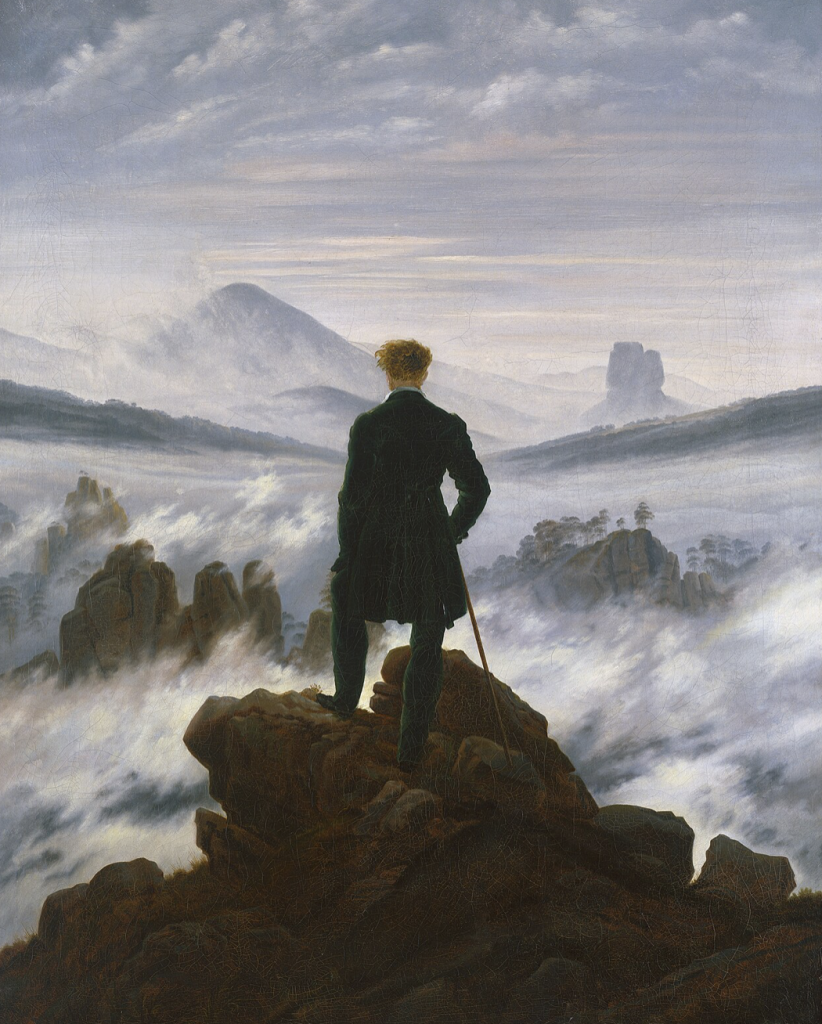
Caspar David Friedrich stands at the summit of this tendency. His Wanderer above the Sea of Fog (1818) is, on its surface, a picture of a single man contemplating a misty German valley. But the painting is doing far more ideological work than that surface suggests. The figure is unnamed, classless, anonymous — he could be any German. He stands in absolute command of a landscape that unfolds beneath him like a birthright. The fog obscures particular towns, particular borders, particular political realities, leaving only the essential: German earth, German sky, German spirit. Friedrich’s repeated motifs — gnarled oaks, Gothic spires glimpsed through winter pines, the Baltic shore at dawn — were not simply picturesque choices. They were a carefully assembled vocabulary of German-ness, drawn at a moment when Germany as a political entity did not yet exist. Art, in Friedrich’s hands, conjured the nation before its politicians could.
Delacroix and the Republic
If Friedrich gave nationalism its landscapes, Eugène Delacroix gave it its people. Liberty Leading the People (1830) is perhaps the most nakedly political canvas of the entire Romantic era. Painted in the white heat following the July Revolution, it shows an allegorical female figure — bare-breasted, tricolor in hand — leading a motley coalition of Parisians over the bodies of the fallen. She is not simply Liberty: she is France, bodied forth, urgent, unstoppable. The painting collapses the distinction between mythological allegory and street reportage, between the timeless and the topical. It insists that the French nation is not an administrative category but a living, breathing, fighting organism.
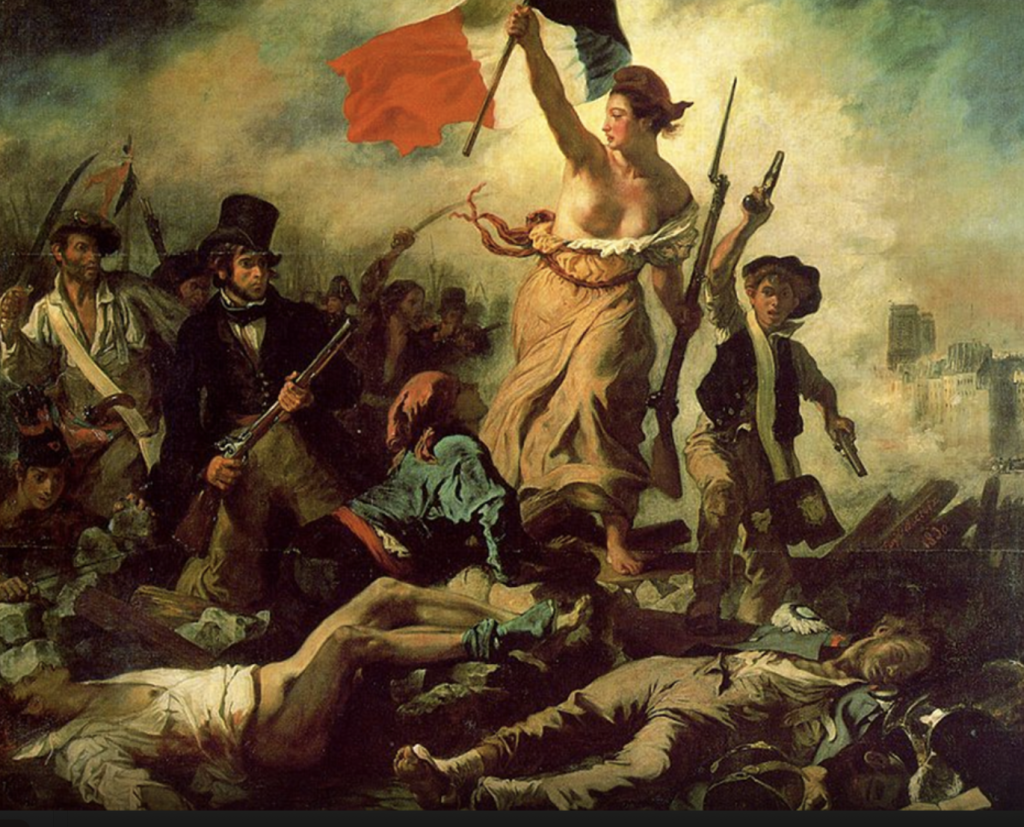
The painting’s compositional brilliance — its diagonal thrust, its intermingling of the real and the allegorical, its refusal to idealize the dead — made it immediately controversial. The July Monarchy purchased it and then promptly hid it from public view, fearing its incendiary power. This suppression is itself revealing: the government understood perfectly that the painting was not a record of an event but a prescription for one. It told the French that revolution was heroic, that the nation’s spirit was indestructible, and that Liberty herself was on their side. These were not comfortable ideas for any regime to leave hanging in a salon.
Folk Memory and the Construction of Tradition
Across Europe, the Romantic preoccupation with folk culture — ballads, legends, costumes, dances — fed directly into the visual arts. In Scandinavia, painters like Johan Christian Dahl documented Norwegian fjords and peasant life with the zeal of ethnographers, constructing a visual archive of a culture that Norwegian nationalists could claim as distinctively, irrecoverably theirs — this at a moment when Norway was politically subordinate first to Denmark and then to Sweden. In Hungary, in Poland, in Bohemia, landscape and folk genre painting served similarly separatist functions, insisting through the evidence of beauty and particularity that these places had souls that could not be absorbed into multinational empires.
The British tradition was not immune. J.M.W. Turner’s seascapes, with their emphasis on naval might and oceanic freedom, spoke a specifically English language of empire and mercantile destiny. The Pre-Raphaelites, looking backward to medieval England, constructed a mythology of Anglo-Saxon virtue and spiritual purity that would prove disturbingly portable — appropriated, in later decades, by various shades of reactionary nationalism.
It is essential to recognise the intellectual sleight-of-hand at the heart of Romantic nationalism in art. The landscapes these painters depicted were never neutral. They were always already encoded: the Rhine valley meant German-ness, the Scottish Highlands meant Celtic freedom, the Campagna meant the eternal Roman spirit. But landscapes are, in reality, indifferent to national identity. They predate nations by geological epochs. To insist that a particular arrangement of hills and mist constitutes the “soul” of a people is to perform an act of imaginative violence — a transformation of contingent geography into eternal destiny.
The artists themselves were rarely innocent of this operation. Many were deeply entangled with the nationalist movements of their day. Friedrich had connections to the German patriotic student movement, the Burschenschaft. Delacroix moved in liberal republican circles. The relationship between aesthetic sensibility and political ideology was not accidental but structural: Romanticism needed nationalism’s passion, and nationalism needed Romanticism’s images. Together they produced a visual culture of extraordinary beauty and extraordinary danger a beauty so compelling that its political freight was, for generations, easy to overlook. By the mid-nineteenth century, the vocabulary had been established. The nation had a face, a landscape, a heroic body, and a folk memory, all rendered in oils and available for reproduction, exhibition, and political deployment.
Part 2: Monuments, Memory, and the Making of National Myth
The age of the monument arrived with the age of the unified nation-state. The decades following the unifications of Germany and Italy in 1870–71, and the crystallisation of imperial ambitions across Europe and North America, produced a tidal wave of public sculpture, triumphal architecture, and commemorative art on a scale without precedent. Cities were transformed into open-air museums of national glory, their squares and parks populated with bronze generals, allegorical goddesses, and granite plinths bearing the names of battles. The monument, it seemed, was the definitive form for the definitive era of nationalism.
The impulse to monumentalise was not, of course, entirely new. Rome had its columns; medieval Europe its cathedrals. But the late nineteenth century monument was different in kind as well as scale. Where older commemorative art had celebrated dynasties, religious institutions, or individual acts of princely patronage, the new public sculpture claimed to represent the nation itself — a collective entity, an imagined community of millions, speaking in bronze across time. The audience was not the court but the citizenry, and the monuments were designed to work on that citizenry in specific, calculable ways: to instil pride, to legitimise sacrifice, to make the nation feel inevitable.
Germania and Her Sisters
The newly unified German Empire produced some of the era’s most explicitly nationalist monumental art. The Niederwalddenkmal, unveiled in 1883 above the Rhine at Rüdesheim, offers a paradigmatic example. Its central figure a colossal personification of Germania, thirty-eight feet high and weighing approximately thirty-two tonnes holds aloft the imperial crown of Germany, her gaze fixed westward toward France. Every element of the monument’s composition speaks the language of national triumphalism: the crown recovered from French humiliation in the Franco-Prussian War, the inscriptions invoking God and Emperor, the relief panels showing the mobilisation of German armies. The Rhine itself, that most symbolically laden of European rivers, becomes the natural base for the nation’s apotheosis.
What is striking about such monuments is the degree to which they operate through mythologisation rather than historical accuracy. Germania is not a historical figure; she is a projection. The “German people” she supposedly represents were in reality a diverse population with sharply conflicting political interests, class allegiances, religious affiliations, and regional loyalties. The monument papers over all of this heterogeneity with a single monolithic image of unified national will. It performs what the political theorist Benedict Anderson would later call the “homogeneous, empty time” of nationalism a flattening of complexity into a single, shared national experience.
American Myth-Making in Marble
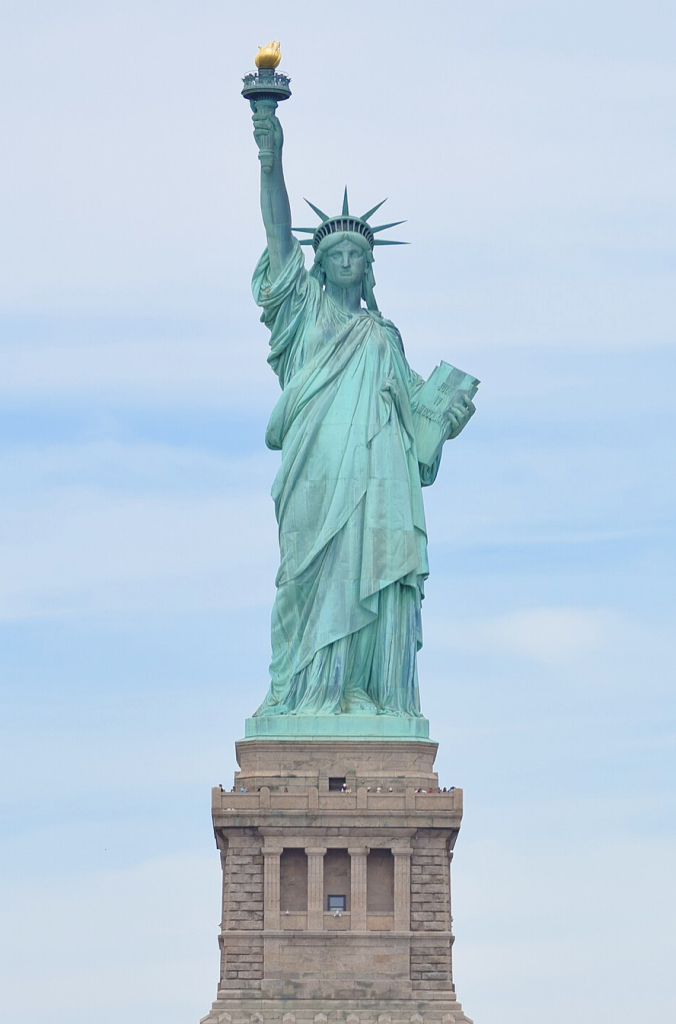
Across the Atlantic, the United States was engaged in its own monumental programme, and with its own peculiar contradictions. The Statue of Liberty (1886), designed by Frédéric Auguste Bartholdi and engineered by Gustave Eiffel, was originally conceived as a celebration of the shared values of French and American republicanism. But it was quickly recruited into a specifically American national mythology, becoming inseparable from the narrative of immigration, opportunity, and the “huddled masses” of Emma Lazarus’s sonnet. The monument thus performed a double function: it offered a universal, humanistic ideal while simultaneously anchoring that ideal to a particular national identity. America became Liberty; Liberty became America.
Less examined, though no less significant, is the period’s extensive programe of Confederate monuments in the American South. Between roughly 1890 and 1920, hundreds of statues of Confederate generals and soldiers were erected in town squares, courthouse lawns, and state capitals across the former Confederacy. This was not, as later apologists would claim, merely an act of commemoration. It was a systematic campaign of national myth-making in stone: an insistence that the Confederate cause had been noble, that the Lost Cause narrative was history rather than ideology, and that the racial hierarchy of the antebellum South retained moral legitimacy. The monuments were built not by veterans but by their children and grandchildren, at a moment of intensifying racial terror and Jim Crow legislation. They were designed to intimidate as much as to commemorate.
The Architecture of Imperial Identity
Monumental nationalism in the late nineteenth century was not confined to sculpture. Architecture was equally, perhaps more powerfully, enlisted in the service of national identity. The rebuilding of Paris under Haussmann had already demonstrated how urban form could express imperial ambition. The construction of the Vienna Ringstrasse in the 1860s and 1870s provided the Habsburg Empire with a theatrical stage for its multiethnic imperial pageantry. Berlin’s Siegessäule (Victory Column, 1873) celebrated Prussian military triumphs in a language directly derived from Roman antiquity. The Vittoriano in Rome (begun 1885, completed 1925) attempted to give the recently unified Italian nation a monumental centre to rival the monuments of the ancient city surrounding it — an exercise in temporal compression that produced an architectural object of extraordinary ambition and considerable vulgarity.
In each of these projects, the recourse to classical antiquity was not accidental. The architects and patrons of late nineteenth century nationalist monuments were making a specific claim: that their nation was the legitimate heir to the civilisational tradition of Greece and Rome. This was, of course, a competitive claim. All of Europe’s great powers were simultaneously making it. The result was a kind of architectural arms race in which the past was endlessly plundered for legitimating imagery, and in which the original meanings of classical forms were systematically distorted to serve present political ends.
By 1914 — the eve of the catastrophe that would put all this monumental confidence to the test — Europe and the Americas were covered in a dense layer of nationalist art and architecture. Bronze generals stood in every capital; allegorical maidens represented every nation on parliamentary facades; murals in government buildings depicted founding myths and military victories. The landscape of public space had been thoroughly nationalised.
But the monument-builders of the late nineteenth century had also, inadvertently, prepared the aesthetic toolkit that the following century’s totalitarian movements would inherit and radicalise. The colossal scale, the claim to eternal values, the reduction of complex social reality to a single heroic image, the use of public space as a theatre for ideological performance — all of these were prefigured in the monuments of the 1870s to 1914. The dictators of the twentieth century did not invent a new aesthetic of power. They inherited one, and took it to its logical, lethal extreme.
part 3: The State as Muse:Art Under Totalitarianism
No century weaponised art more systematically, or more lethally, than the twentieth. The totalitarian regimes that rose and fell between the First World War and the death of Stalin in 1953. Soviet Communism, Italian Fascism, German National Socialism, and their many variants and satellites — all understood, with a clarity that liberal democracies often failed to match, that art was not decorative but constitutive. It did not merely reflect a society’s values; it shaped them. The commissioning, censoring, and mass-distributing of art was therefore not a cultural policy. It was a political technology, as fundamental to the exercise of power as the secret police or the concentration camp.
The Soviet experiment came first and in many ways set the template. The Bolshevik revolution of 1917 inherited a tradition of avant-garde art of extraordinary vitality — Constructivism, Suprematism, Futurism’s Russian variants — and initially embraced it. Artists like El Lissitzky, Alexander Rodchenko, and Varvara Stepanova threw themselves into the revolution’s visual machinery: designing propaganda posters, exhibitions, textile patterns, typographic systems that expressed in formal terms the new society’s dynamism and rationality. These were genuinely great works of art that happened also to be instruments of political persuasion. For a brief, brilliant moment, the avant-garde and the revolutionary state seemed to share a common project.
The Stalinist Freeze
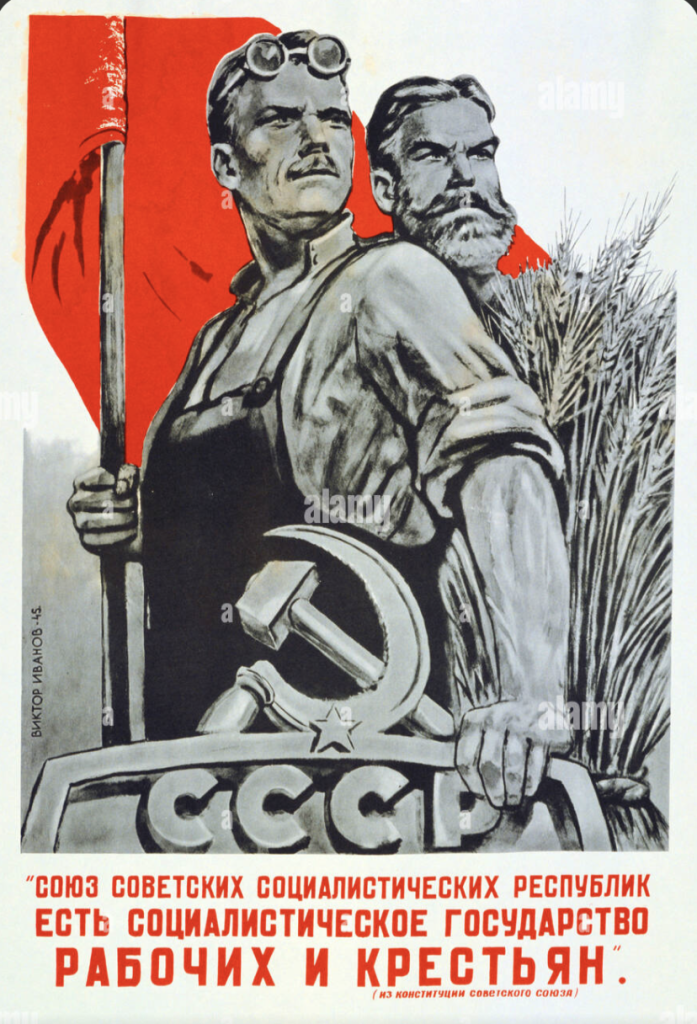
That moment did not last. By the early 1930s, Stalin’s consolidation of power had produced the doctrine of Socialist Realism, promulgated as the mandatory aesthetic of Soviet art. The avant-garde experiment was over. Abstraction, formal experimentation, and aesthetic difficulty were denounced as “formalism” — a bourgeois evasion of the artist’s duty to serve the people. In their place was demanded a style at once technically accomplished and ideologically transparent: paintings and sculptures that showed Soviet citizens as heroic, the socialist future as radiant and inevitable, and Stalin himself as the benevolent genius presiding over it all.
The machinery of enforcement was comprehensive. The Union of Soviet Artists controlled access to studios, materials, exhibition spaces, and commissions. Artists who deviated from the approved aesthetic risked loss of employment, public denunciation, imprisonment, and, in Stalin’s worst years, death. The result was a vast, technically often impressive, ideologically suffocating body of work: monumental canvases of collective farm workers greeting the dawn; sculptures of Red Army soldiers in postures borrowed directly from classical antiquity; portraits of Lenin and Stalin that would have been recognisable to any Byzantine icon painter. Socialist Realism was, in its way, a triumph of nationalist art — except that the “nation” being celebrated was an idea (the international proletariat, the Soviet state) rather than an ethnicity, and the triumphalism concealed a terror of almost incomprehensible scale.
The Fascist Aesthetic
Italian Fascism under Mussolini produced a more aesthetically heterodox visual culture than is sometimes acknowledged. Mussolini himself was genuinely ambivalent about modernism: he initially patronised Futurism (whose celebration of speed, violence, and national virility seemed tailor-made for Fascist ideology) before eventually settling on a more eclectic, rhetorically classical aesthetic that served his regime’s claim to be the Third Rome. The Palazzo della Civiltà Italiana in Rome (1938–43) — known colloquially as the “Square Colosseum” — captures this double allegiance perfectly: a modernist grid structure whose repeating arches invoke the Roman aqueduct and the triumphal arch simultaneously.
Fascist Italy’s public art programme was extensive and visually sophisticated. Murals, mosaics, and sculptures commissioned for the new government buildings of Rome, Florence, and other cities frequently employed modernist formal devices — abstraction, graphic simplification, bold colour in the service of unambiguously nationalist content: scenes of Roman history, allegories of Italian virtues, portraits of the Duce. This paradox aesthetic modernity combined with ideological reaction gave Italian Fascist art a complexity that the blunter instruments of Nazi aesthetics largely lacked.
Nazi Art and the Aestheticisation of Politics
National Socialism’s cultural programme was both more systematically destructive and more aesthetically coherent than Italy’s. The regime’s cultural administrators, led initially by Joseph Goebbels and later contested by Alfred Rosenberg, moved with extraordinary speed to eliminate competing aesthetic visions. The opening of the “Degenerate Art” exhibition (Entartete Kunst) in Munich in 1937 — which showcased modernist works alongside psychiatric patients’ drawings and racist caricatures, explicitly linking aesthetic experimentation with racial “corruption” — was matched by the simultaneous opening of the “Great German Art Exhibition” in the newly built House of German Art, which presented the regime’s approved aesthetic: monumental nudes and heroic peasant farmers rendered in a hyperrealist style that owed as much to nineteenth-century academic painting as to any modern development.
Walter Benjamin’s famous 1936 essay on the work of art in the age of mechanical reproduction articulated what was happening with frightening precision: fascism, he wrote, aestheticised politics. It transformed political life into a theatrical spectacle — the mass rally, the choreographed march, the monumental architectural stage-set — in which the population became simultaneously audience and performer of national mythology. Leni Riefenstahl’s Triumph of the Will (1935) remains the most disturbing example: a film so visually seductive, so technically accomplished, so adept at transforming a political rally into a religious ceremony, that its ideological content becomes almost secondary to its aesthetic achievement. This is precisely what made it, and makes it still, so dangerous.
Nationalist Art’s Darkest Mirror
The totalitarian art of the twentieth century forces us to confront an uncomfortable truth about nationalist aesthetics as a whole. The formal strategies that made Romantic nationalism so emotionally powerful the appeal to blood and soil, the use of the heroic body to personify collective will, the claim that the nation is a natural rather than a constructed entity were always potentially available for the most extreme political purposes. What Nazi and Soviet art did was not to corrupt an innocent tradition but to reveal one of its inherent possibilities. The Romantic nationalist painting of the nineteenth century was not fascism avant la lettre; but it prepared a visual language that fascism could speak fluently. Understanding how that happened understanding the formal and ideological continuities as well as the ruptures — remains one of the most urgent tasks in the history of art.
Part 4. Postcolonial and Contemporary Resistance
If the history of nationalism in art is, in part, a history of images wielded as weapons of domination, it is equally a history of those weapons being seized, broken, and repurposed. From the independence movements of the mid-twentieth century to the monument debates and decolonial art practices of the present day, artists, communities, and institutions have been engaged in a sustained reckoning with the nationalist visual inheritance — questioning what images nations construct, who those images serve, and what it might mean to imagine collective identity differently.
The postcolonial moment in art did not emerge in a vacuum. It grew from the same intellectual soil as the broader decolonisation movements: from Frantz Fanon’s analysis of colonial psychology, from the Négritude literary and artistic movement founded in the 1930s by Aimé Césaire, Léon-Gontran Damas, and Léopold Sédar Senghor, from the Non-Aligned Movement’s political assertion that the world was not simply divided between Western and Soviet blocs. Artists across Africa, Asia, Latin America, and the Caribbean were confronting a specific problem: how do you construct a national or cultural identity for a newly independent nation when the available visual languages are largely those of the coloniser?
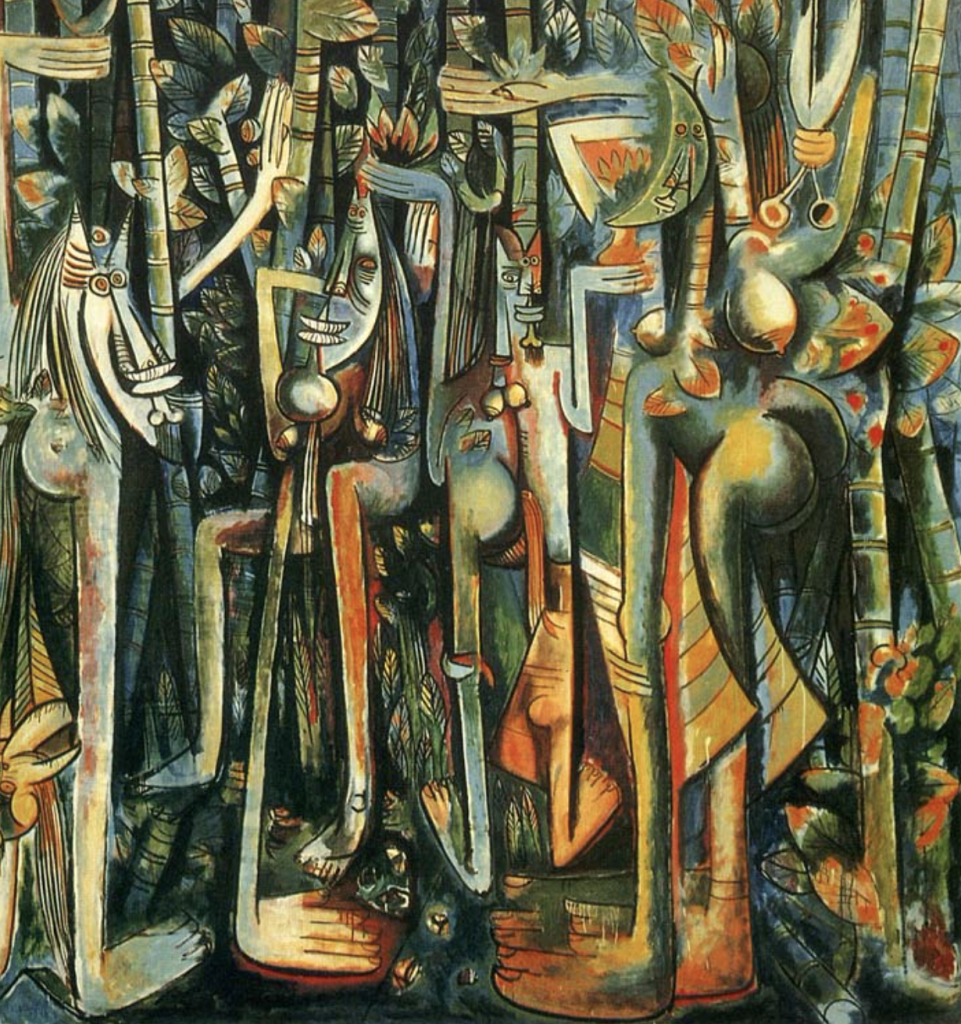
Wifredo Lam’s The Jungle (1943) offers one of the most sophisticated early answers to this dilemma. Painted in Havana after Lam’s return from Europe — where he had encountered Picasso, the Surrealists, and the beginnings of his own artistic maturity — the work refuses any simple nationalist iconography. Its towering, hybrid figures combine the formal vocabulary of African sculpture (which Lam had encountered via the Cubists as well as through his own Afro-Cuban heritage) with Surrealist spatial distortion and an imagery drawn from the syncretic religious traditions of the Caribbean. There is no allegorical goddess here, no heroic national body, no landscape of destiny. Instead there is a dense, almost claustrophobic proliferation of bodies that are simultaneously human, animal, plant, and divine — a world in which stable identities dissolve and recombine.
This refusal of stable national identity was not evasion but strategy. Lam understood that the colonial visual system depended on fixing identities in place — the colonised as exotic, primitive, passive, in need of civilising — and that the most effective response was not to reverse these valuations (celebrating the previously denigrated) but to destabilise the entire system of categorisation. His paintings do not show you what Cuban or African or Caribbean identity “really” looks like. They show you that identity is a process, not a possession.
The Monument Wars
While painters and photographers were working through these questions in studios and galleries, a parallel battle was being fought in public space. The late twentieth and early twenty-first century produced a global wave of monument contestation — demands, often fiercely resisted, to remove, contextualise, or transform the statues and memorials that nationalist and colonial movements had erected in previous centuries.
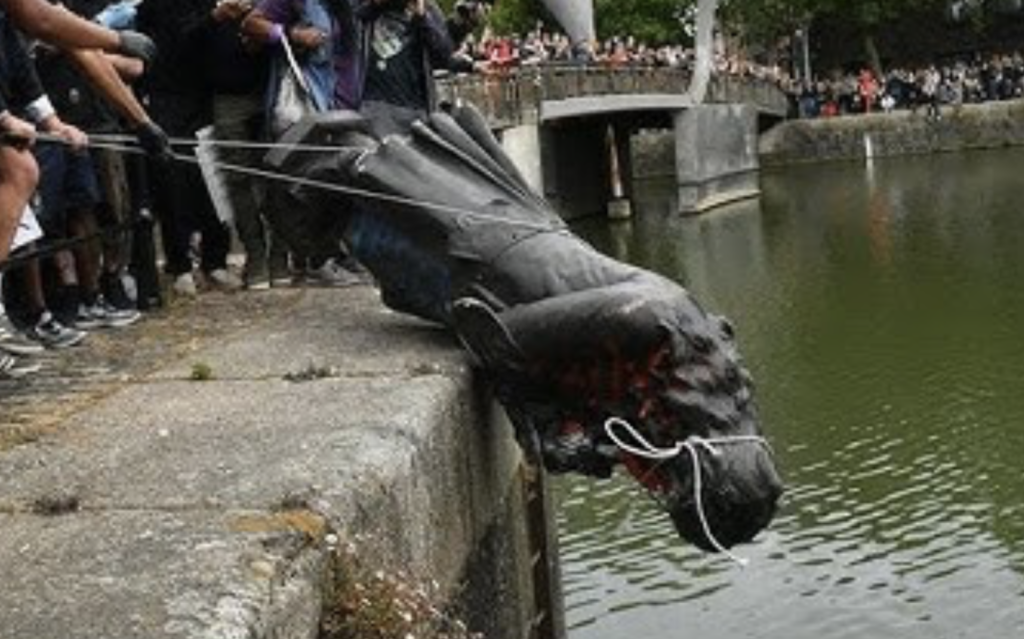
The toppling of the statue of Edward Colston in Bristol in June 2020, during the Black Lives Matter protests, was perhaps the most dramatic single episode in this ongoing struggle. Colston was a seventeenth-century merchant whose fortune was built substantially on the transatlantic slave trade; his statue had stood in the centre of Bristol since 1895, the product of a specific Victorian campaign to rehabilitate his memory and present him as a philanthropic civic benefactor. Some viewed the act as not simply destroying a bronze object, but that the protesters were performing a critical act of historical analysis: insisting that the monument’s narrative was a lie, and that the public space it occupied was not neutral but contested.
Kara Walker and the Counter-Monument
In the space of gallery and installation art, no artist has engaged more powerfully with the visual legacy of nationalist and racial mythology than Kara Walker. Working primarily in large-scale cut-paper silhouettes — a technique borrowed from the genteel parlour art of the nineteenth century — Walker has spent three decades creating images of extraordinary violence and complexity drawn from the history of American slavery. Her tableaux are simultaneously archival and fantastical: they reference specific historical practices while transforming them through formal abstraction and a mordant, uncomfortable humour.
Walker’s 2014 installation A Subtlety, or the Marvelous Sugar Baby, created inside the Domino Sugar refinery in Brooklyn before its demolition, is among the most discussed works of contemporary art. The central figure — a colossal sphinx with African-American features and a white sugar body — occupied the industrial space with imperial authority while simultaneously quoting the plantation system’s economy of sugar and enslaved labour, the exoticising traditions of Orientalist art, and the decorative sugar confections (subtleties) that European aristocrats had commissioned as table entertainments, often using enslaved sugar workers to produce them. The work did not offer a counter-nationalist mythology; it offered something more demanding: a sustained, unresolvable meditation on how images of power are constructed and what it costs the bodies they are built upon.
Indigenous Resurgence and the Politics of Visibility
Alongside the critique of colonial monuments and the counter-historical interventions of artists like Walker, a distinct but related strand of contemporary art has been concerned with Indigenous cultural resurgence: with making visible traditions, cosmologies, and forms of belonging that colonial nationalism had sought to erase or folklorise. From the political paintings of Australian Aboriginal artists in the Western Desert tradition — whose dot paintings, first brought to canvas in the 1970s, encode within their apparently abstract surfaces detailed maps of ceremonial sites, ancestral narratives, and systems of land ownership that predate European settlement by tens of thousands of years — to the work of Māori artists in New Zealand and First Nations artists in North America, this body of work insists on the existence of alternative nationalisms: forms of collective identity rooted in land, language, and ceremony that are not the products of nineteenth-century Romantic invention but of far older, more intricate, and more sustainable relationships with place.
The New Zealand-based artist Lisa Reihana’s monumental panoramic video work in Pursuit of Venus, shown at the Venice Biennale in 2017, offers a particularly striking example. Taking as its starting point the eighteenth-century French wallpaper panorama Les Sauvages de la Mer Pacifique — which depicted Pacific Islander peoples in a deliberately Arcadian, ethnographic register for European consumption — Reihana restages its scenes with Māori performers, inserting histories of contact, resistance, and colonial violence that the original had systematically suppressed. It is a work of nationalist art in the fullest sense: it constructs and affirms a collective identity. But the nationality it affirms is Indigenous, not colonial, and the history it tells is of dispossession rather than triumph.
Contemporary Nationalism: The Image Returns
Alongside the critique of colonial monuments and the counter-historical interventions of artists like Walker, a distinct but related strand of contemporary art has been concerned with Indigenous cultural resurgence: with making visible traditions, cosmologies, and forms of belonging that colonial nationalism had sought to erase or folklorise. From the political paintings of Australian Aboriginal artists in the Western Desert tradition — whose dot paintings, first brought to canvas in the 1970s, encode within their apparently abstract surfaces detailed maps of ceremonial sites, ancestral narratives, and systems of land ownership that predate European settlement by tens of thousands of years — to the work of Māori artists in New Zealand and First Nations artists in North America, this body of work insists on the existence of alternative nationalisms: forms of collective identity rooted in land, language, and ceremony that are not the products of nineteenth-century Romantic invention but of far older, more intricate, and more sustainable relationships with place.
The New Zealand-based artist Lisa Reihana’s monumental panoramic video work in Pursuit of Venus, ( infected), shown at the Venice Biennale in 2017, offers a particularly striking example. Taking as its starting point the eighteenth-century French wallpaper panorama Les Sauvages de la Mer Pacifique which depicted Pacific Islander peoples in a deliberately Arcadian, ethnographic register for European consumption — Reihana restages its scenes with Māori performers, inserting histories of contact, resistance, and colonial violence that the original had systematically suppressed. It is a work of nationalist art in the fullest sense: it constructs and affirms a collective identity. But the nationality it affirms is Indigenous, not colonial, and the history it tells is of dispossession rather than triumph.
It would be comforting to conclude that the relationship between art and nationalism has, in the contemporary period, been straightforwardly resolved in favour of critical resistance and decolonial reckoning. It has not. The twenty-first century has seen a significant resurgence of explicitly nationalist aesthetics in the art of right-wing and populist political movements: from the nostalgic realism favoured by Viktor Orbán’s cultural institutions in Hungary, which explicitly invokes the Romantic nationalist tradition, to the quasi-fascist visual culture of the American alt-right, which mines nineteenth-century European nationalist imagery for memes and symbols with a technical sophistication that would have delighted Goebbels. The image, it turns out, does not retire. It migrates.
This makes the work of critical art history — and of artists who engage historically and analytically with the visual legacy of nationalism more urgent than ever. The great paintings of the Romantic era are not innocent because they are beautiful. The monuments of the late nineteenth century are not neutral because they are old. The propaganda of the totalitarian period is not safely confined to the past because it is documented in museums. All of these images remain active in the present, available for deployment, available for contestation, available for reclamation. The question every generation must answer, in its own terms and with its own images, is not whether nationalism will use art, but what art will do with nationalism — and in whose name.
The artists who have been the most genuinely challenging Lam, Walker, Reihana, and many others not discussed here — have refused the false choice between nationalist triumphalism and depoliticised aestheticism. They have insisted that art can be both formally ambitious and historically responsible, both visually seductive and intellectually rigorous. That insistence is not merely an artistic position. It is a political one: a refusal to cede the power of the image to those who would use it to flatten, exclude, and dominate. In a world in which the image has never been more powerful or more contested, it is also, perhaps, the only adequate response.