New Objectivity and The Pitiless Eye
Otto Dix looked at the wreckage of the Great War and refused to look away. In doing so, he forged the movement — Neue Sachlichkeit — that remains the most uncomfortable mirror modern art has ever held up to modernity.
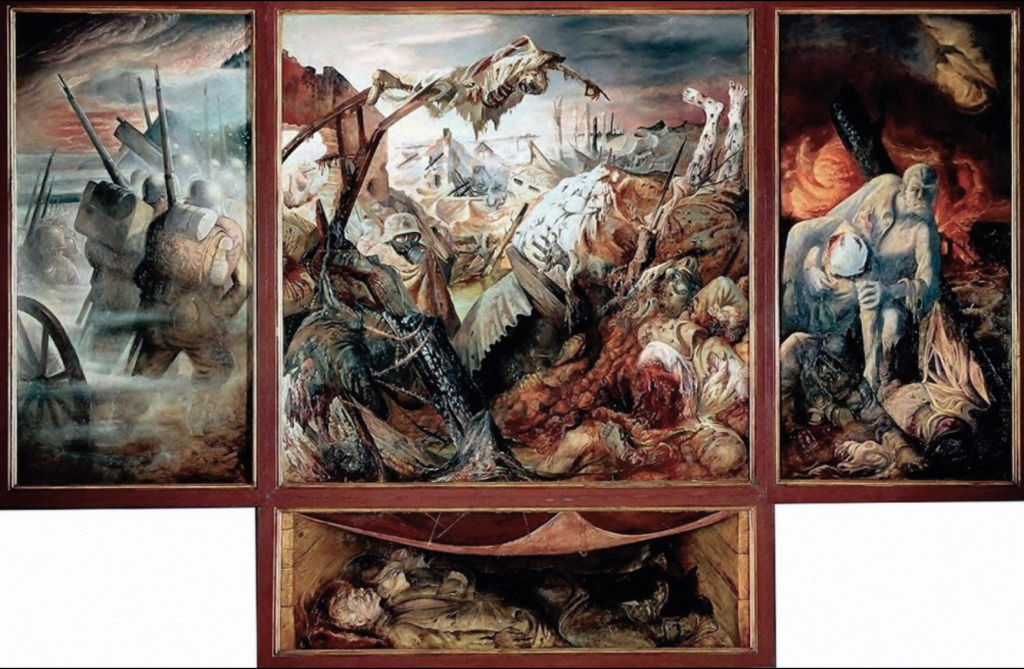
There is a painting in the Kunstmuseum Stuttgart that most first-time visitors approach and then retreat from. It is large — nearly two and a half metres wide — and it shows three panels of a battlefield: mud, wire, rats, decomposing bodies, a soldier advancing through a gas cloud with the blank purpose of a machine. It was painted not in the heat of battle but nine years after the guns fell silent, by a man who had carried a sketch pad through four years of trench warfare and could not stop seeing what he had seen. The painting is the War Triptych (1929–32), and its painter was Otto Dix.
Dix was born in 1891 in Untermhaus, Thuringia, the son of an iron foundry worker. He trained at the Dresden School of Arts and Crafts, absorbing the lessons of German Expressionism and a fierce enthusiasm for Nietzsche, before volunteering for the Imperial Army in 1914. He served on the Eastern and Western fronts, survived the Battle of the Somme, was wounded four times, and rose to the rank of vizefeldwebel — staff sergeant. He also drew obsessively throughout, filling notebooks with the faces of the dying and the dead with a draughtsman’s detachment that his contemporaries found deeply unsettling. It was, he would later say, a form of self-protection: to look at a thing steadily enough that it could not destroy you.
“I had to experience how someone beside me suddenly falls over and is dead and the bullet has hit him squarely. I had to experience that quite directly. I wanted it. I’m therefore not a pacifist at all — or am I?”
— Otto Dix
The movement now known as Neue Sachlichkeit – New Objectivity, emerged in Germany in the early 1920s as a deliberate reaction against Expressionism’s emotional excess. Where Expressionism had distorted the world to express interior states, the new painters insisted on looking at exterior reality with clinical, unsparing precision. The galvanising institutional moment came in 1925, when Gustav Hartlaub, director of the Kunsthalle Mannheim, mounted an exhibition under the title “Neue Sachlichkeit: German Painting since Expressionism.” Hartlaub identified two divergent strands within the movement: the “veristic” wing cold, socially engaged, forensic led by Dix and George Grosz; and the “classicist” wing quieter, more inward, influenced by Italian pittura metafisica represented by Georg Schrimpf and Alexander Kanoldt.
It was the veristic painters who made history. Dix and Grosz shared a mordant fury at the Weimar Republic’s failure to reckon with the war’s causes and costs, the profiteers who had grown fat while soldiers died, the generals who parlayed catastrophe into memoirs, the maimed veterans begging on the streets of a society that preferred not to see them. Their art was an act of enforced seeing.
THE PORTRAIT AS INDICTMENT
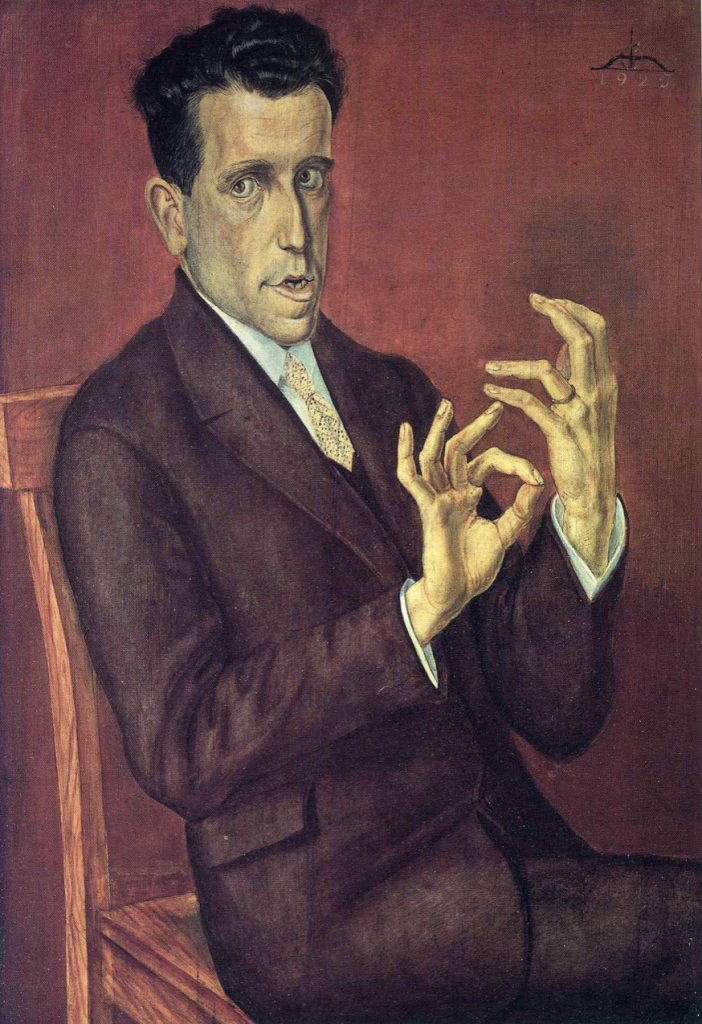
Dix’s portraiture occupies a category of its own in the history of the genre. The tradition of painted portraiture carries an implicit contract: the painter flatters, or at minimum dignifies, the sitter. Dix tore up the contract. His subjects art dealers, journalists, collectors, socialites, physicians are rendered with a precision that leaves nowhere to hide. Pores are visible. Jowls sag. Eyes carry the precise quality of their owner’s vanity, anxiety, or greed. The technique draws on the Northern Renaissance masters Dix adored Cranach, Holbein, Dürer, translated into the context of a society that Dix regarded as terminally corrupt.
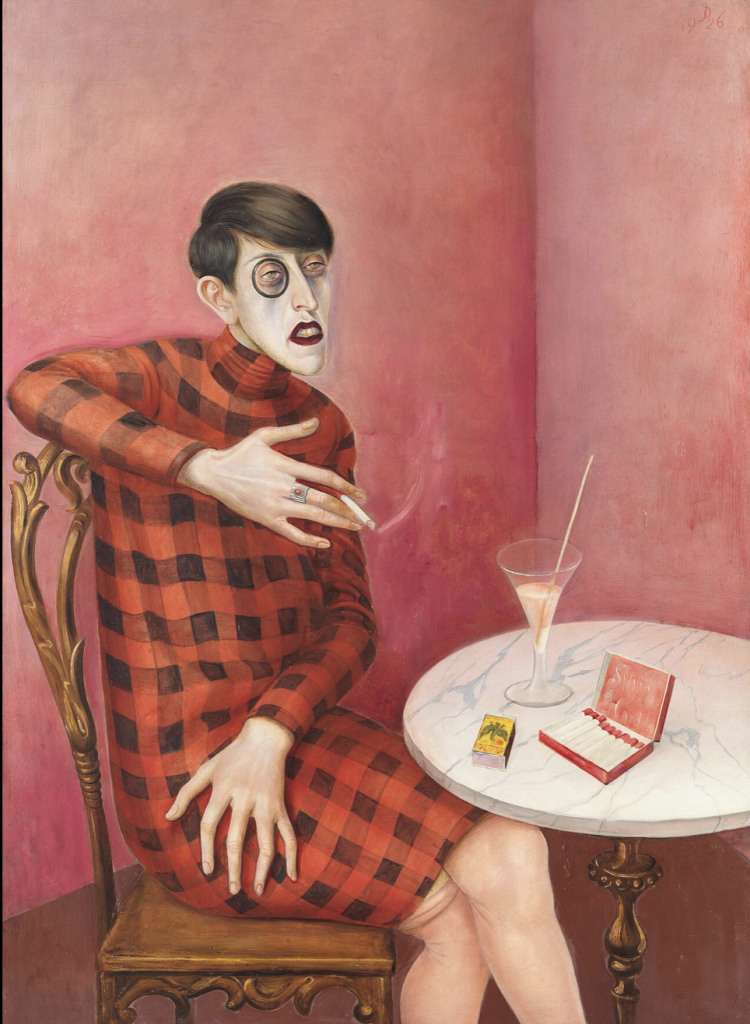
The Portrait of the Journalist Sylvia von Harden (1926) is perhaps the supreme example. Von Harden sits at a café table, monocled, cigarette in long holder, cocktail before her, her androgynous figure and angular face rendered in colours that are simultaneously garish and funereal. She is the New Woman of Weimar Germany, emancipated, urban, intellectually confident and Dix paints her as a symptom as much as an individual. He reportedly approached her on a Berlin street and said he “must” paint her because she represented “an entire epoch.” The painting hangs today in the Pompidou Centre and retains, a century later, its quality of acute discomfort.
WAR: THE RETURN OF THE REPRESSED
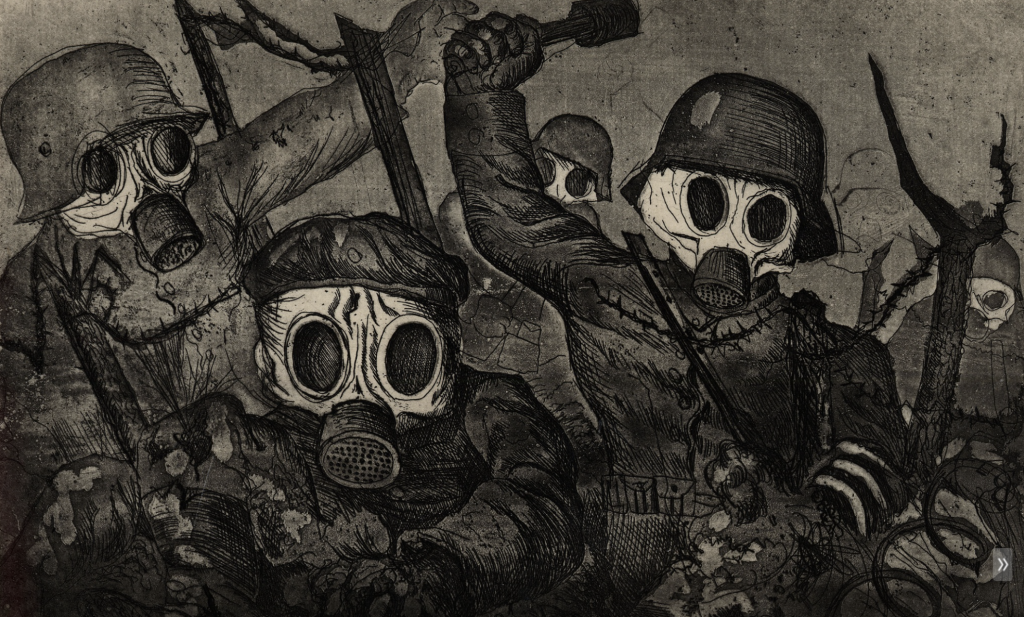
Dix began his etchings cycle Der Krieg (The War) in 1924, producing fifty prints modelled explicitly on Goya’s Disasters of War. The cycle circulated in a portfolio that caused immediate scandal and was used in anti-war exhibitions across Germany through the late 1920s. Where official commemoration was building its grammar of heroism and sacrifice, Dix’s prints showed gas victims, rotting corpses, soldiers reduced to biological matter. They were an act of counter-memory a refusal to let the war be assimilated into any usable national narrative.
The War Triptych itself, completed between 1929 and 1932, extends this project into monumental painting. Dix employed the form of the medieval altarpiece, predella, three main panels, hinged wings with deliberate irony: the sacred form of devotion repurposed for the worst thing human beings had done to one another. The left panel shows troops advancing at dawn. The centre panel — the altarpiece’s “crucifixion” shows a no-man’s-land of unprecedented devastation. The right panel shows a soldier (Dix himself, identifiable by physiognomy) carrying a wounded comrade. The predella below shows soldiers sleeping or dead, one cannot be certain, which is exactly the point he made.
DEGENERATE ART AND EXILE
The National Socialists came to power in January 1933. By March, Dix had been dismissed from his professorship at the Dresden Academy. In 1937, his work featured prominently in the Entartete Kunst (Degenerate Art) exhibition the Nazi regime’s touring display of modernist work, designed to humiliate it before mass audiences. Some 260 of Dix’s works were confiscated from German museums. The regime understood, correctly, that his war imagery was incompatible with the mythology of martial glory it needed to rebuild.
Dix retreated to Lake Constance and spent the Nazi years painting landscapes in a deliberately innocuous style — what he called “inner emigration.” He survived. After 1945, he returned to figurative work and received increasing recognition in both West and East Germany, dying in Singen in 1969 at the age of seventy-seven.
WHY DIX STILL MATTERS
Contemporary art has developed many sophisticated ways of addressing violence archival, conceptual, participatory, testimonial. Dix’s method was older and in some ways more demanding: he looked, he drew, he painted, he gave the thing a form that the eye cannot easily exit. There is no wall text that mediates between the viewer and the War Triptych. The painting does the work itself, and the work is to make the viewer confront what industrial war does to human bodies, human minds, and human meaning.
In a culture increasingly oriented toward the efficient processing of information, Dix’s art models a counter-practice: slow, visceral, uncompromising attention. The Neue Sachlichkeit painters believed that to see clearly — to refuse the consolations of idealism and sentimentality — was itself a moral act. Whether or not one agrees, one cannot easily shake the feeling, standing before the War Triptych, that Dix was right about what he had seen, and right that we should not be allowed to forget it.