Artivism, When Art Becomes a Weapon
Artivism — the fusion of artistic practice and political urgency — has a history as long as injustice itself. But the internet has transformed it into something new: a global, leaderless, perpetually mutating force.
The term “artvism” — a portmanteau of art and activism — has become common currency in curatorial circles over the past decade. But the practice it describes is ancient. As long as some have wielded power unjustly, others have responded with image, sound, and story. What has changed, profoundly and irreversibly, is the speed, reach, and granularity with which art can now confront power. Here we will try to trace artvism from its roots in revolutionary muralism and Dadaist provocation through to the hyper-networked present, where a single image posted online can ignite or sustain a global movement within hours.
68% OF GEN Z RESPONDENTS SAY ART HAS INFLUENCED THEIR POLITICAL VIEWS
— PEW RESEARCH, 2023
A History Written in Paint and Blood
Political art did not begin with modernism. The cave paintings at Lascaux may have been ritual; the propaganda friezes of Ramesses II at Abu Simbel were certainly not neutral. But it is in the crucible of the 20th century with its mass movements, world wars, and decolonial uprisings that artvism crystallised as a conscious, organised practice.
The Mexican Muralists — Diego Rivera, José Clemente Orozco, and David Alfaro Siqueiros — produced the first large-scale artvism programme of the modern era. Commissioned in the aftermath of the Mexican Revolution, their vast public frescoes depicted workers, indigenous peoples, and colonised histories with a directness that elite gallery culture had never permitted. Rivera’s Detroit Industry Murals (1932–33) placed the human body in dialogue with the machine, celebrating labour while critiquing capital in the same brushstroke.
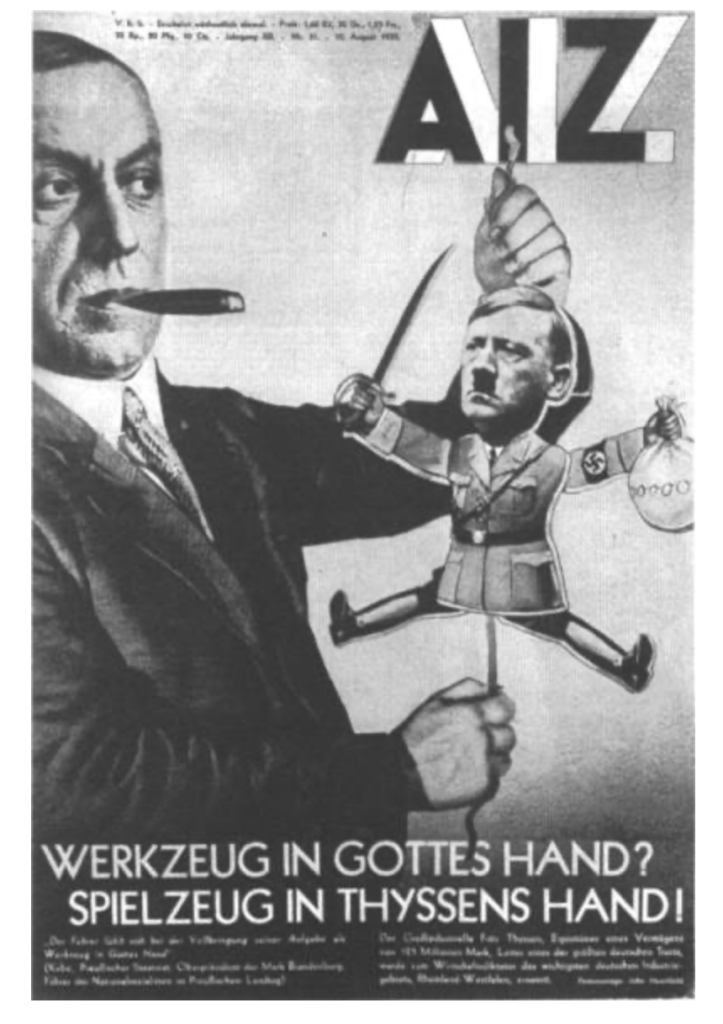
In Europe, the Dadaists had arrived at political art by a different, more corrosive route. Traumatised by the carnage of World War I, artists like John Heartfield weaponised photomontage against the rising Nazi movement. His covers for the Arbeiter-Illustrierte-Zeitung — Hitler as a puppet receiving gold from corporate backers, the swastika as a bloody axe — were distributed to hundreds of thousands of readers, pioneering the use of mass-reproduced images as political weapons.
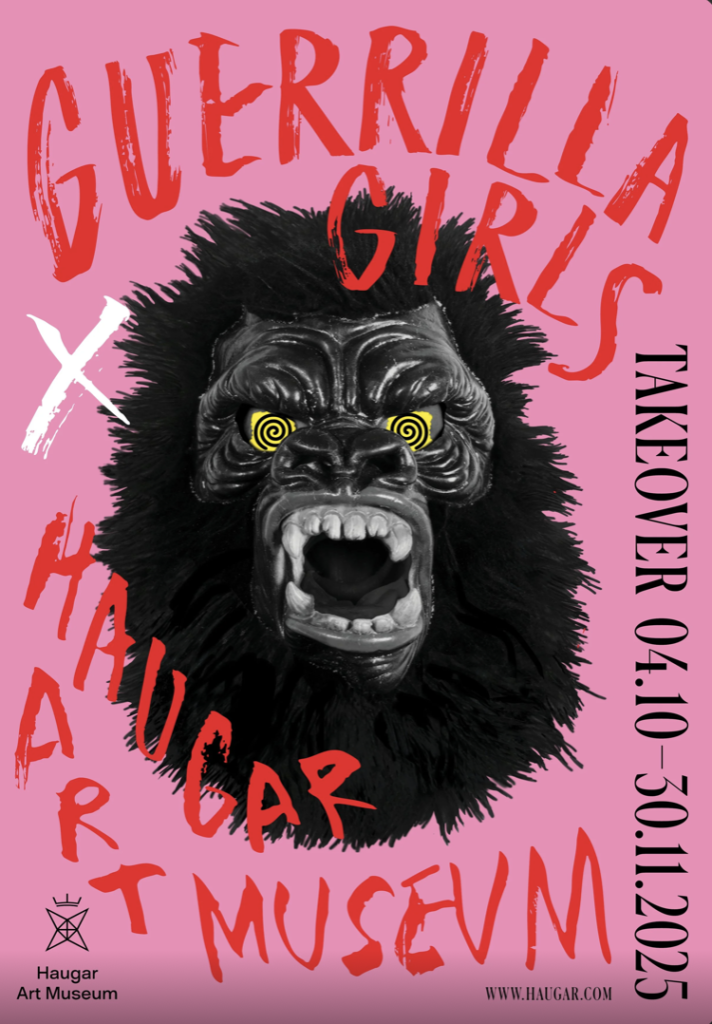
The post-war decades saw artvism diversify into performance (the Situationist International’s détournement, redirecting commercial imagery against itself), feminist interventions (the Guerrilla Girls’ billboard campaigns exposing sexism in the art world from 1985 onwards), and the global spread of politically charged street art. In South Africa, artists under apartheid developed coded visual languages to evade censorship. In Chile under Pinochet, the arpilleristas — predominantly working-class women — sewed tapestries depicting disappearances and state terror, smuggling them out of the country to international audiences.
What unites these disparate practices is an understanding of aesthetics as a form of power — and an insistence on deploying that power on behalf of those marginalised by existing structures.
The Internet Changes Everything
The arrival of the World Wide Web — and more decisively, of social media platforms in the late 2000s — did not invent artvism. It detonated it.
Before the internet, activist art faced fundamental distribution problems. A mural was site-specific. A zine required printing and physical distribution. A gallery intervention reached whoever happened to visit. The internet collapsed these barriers absolutely. An image made in a kitchen in Cairo could circulate globally in minutes. This was not a minor logistical convenience; it was an ontological shift in what activist art could be and do.
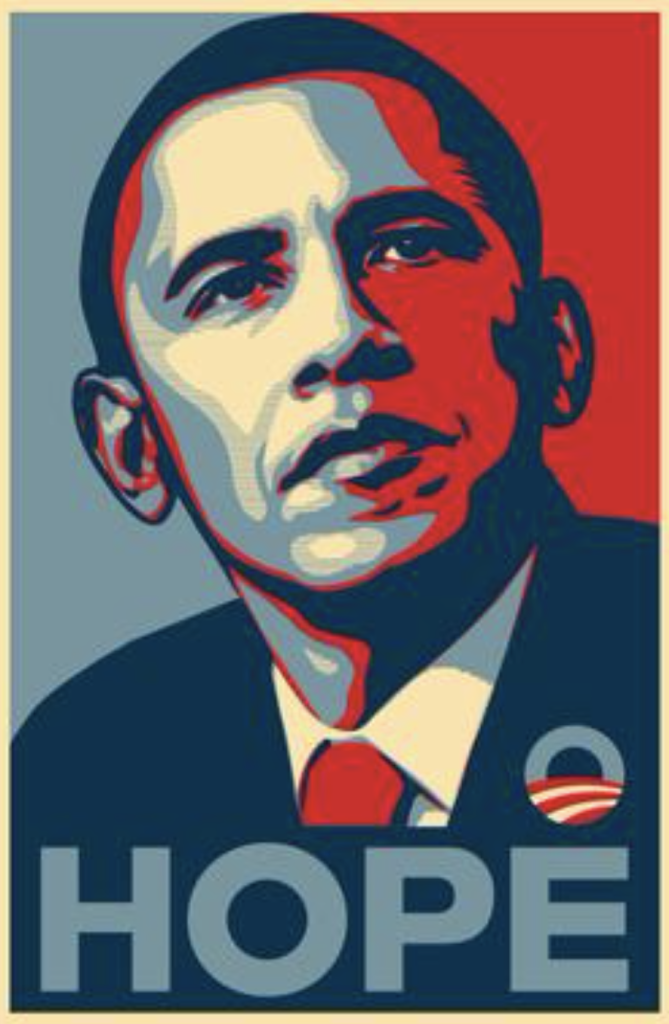
Shepard Fairey’s Hope poster (2008) is the canonical early example. Originating as a wheat-paste print distributed at street level, it was simultaneously photographed, uploaded, remixed, and shared online, reaching an audience of tens of millions. The image demonstrated that the street-to-internet pipeline could create political iconography at a speed and scale previously impossible.
By 2011, the dynamic was fully operational. The Arab Spring’s visual culture — photographs, graffiti, video footage — moved across Twitter and Facebook with astonishing speed, creating a global audience for revolutions as they unfolded. In Cairo’s Tahrir Square, the street artist Keizer and others produced work that would be photographed and circulated internationally within hours of completion. The mural and the tweet had become a single, integrated system.
The algorithm as curator and censor
The internet, however, is not a neutral conduit. Platform algorithms reward engagement, and engagement is biased toward the spectacular, the outrage-inducing, and the emotionally immediate. This has shaped activist aesthetics in profound ways: the most effective artivist images online are often those with the clearest, most immediate emotional impact — an aesthetic of legibility over complexity.
Simultaneously, platforms have proven willing to censor activist content. During the Black Lives Matter protests of 2020, Instagram and Facebook repeatedly removed images of police violence, citing content policies. Palestinian artists and activists have documented systematic suppression of their content. The algorithm giveth virality; the content moderator taketh it away.
This tension has pushed many artivists toward decentralised platforms — Signal channels, Telegram groups, independent websites — and toward strategies of redundancy: ensuring that images are archived across multiple locations before they can be taken down. The cat-and-mouse dynamic between activist art and platform moderation is one of the defining creative constraints of 21st-century artvism.
New Movements, New Aesthetics
Contemporary artvism has fragmented into a constellation of movements, each with its own visual language, tactics, and theoretical frameworks. Below, we examine the most significant.
Climate Artvism
The climate crisis has produced a rich and contested body of activist art. Groups like Extinction Rebellion developed a distinctive visual vocabulary — the hourglass symbol, blood-red dye in waterways, spectacular banner drops — that combined traditional protest aesthetics with a theatrical sensibility calculated for photographic reproduction online. More controversial has been the emergence of art attacks on museum collections: activists from Just Stop Oil gluing themselves to Vermeer’s Girl with a Pearl Earring, or throwing soup at Van Gogh’s Sunflowers. The stated logic is disruption — creating images so jarring that they break through media indifference. Critics argue the tactic is counterproductive, alienating potential supporters. The debate is itself generative, producing exactly the extended public conversation about the climate emergency that the actions intended to provoke.
Decolonial and indigenous art practices
The movement to decolonise cultural institutions — and the broader conversation about whose histories are represented in public space — has generated powerful visual interventions. The toppling of statues of slaveholders and colonisers across Europe and North America in 2020 was a form of radical artvism: the removal of one set of images as the installation of another (presence as the absence of oppression).
Indigenous artists including Cannupa Hanska Luger (Mandan/Hidatsa/Arikara/Lakota) have developed practices that fuse traditional craft forms with contemporary installation and performance to assert land rights and cultural continuity. His Mirror Shield Project (2016), which provided water protectors at Standing Rock with mirrored shields, was simultaneously a protective object, a work of art, and a media strategy — the mirrors reflecting images of militarised police back at themselves and at watching cameras.
Queer and trans artvism
LGBTQ+ artvism has a particularly deep history — from the ACT UP poster campaigns of the AIDS crisis (the pink triangle reclaimed from Nazi persecution and transformed into a symbol of survival and militancy) to the contemporary work of artists like Wu Tsang and her collaborators, whose films and performances create spaces of queer world-building.
In the current moment of legislative rollback against trans rights in the United States, United Kingdom, and elsewhere, trans artists and collectives have responded with both documentary practice — archiving lives under threat — and imaginative construction of futures. The aesthetic of trans artvism is often deliberately joyful, asserting the right to exist and flourish against a context of threat.
Digital and AI-assisted artvism
The most recent wave of artivist practice is wrestling with artificial intelligence — both as a tool and as a subject. Artists are using AI image generation to create propaganda that exposes the aesthetics of propaganda; to flood platforms with counter-narratives; to generate documentation of human rights abuses in regions where photography is impossible or dangerous. Meanwhile, other artivists have targeted AI systems themselves, embedding adversarial patterns into images to confuse facial recognition systems used by authoritarian states.
Most Used Styles and Techniques
Certain aesthetic modes recur across artivist traditions, shaped by their effectiveness in creating legible political messages and circulating across media.
Street art and muralism
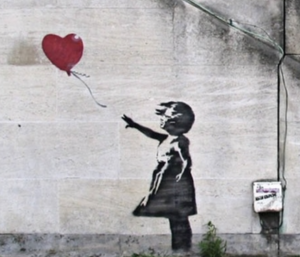
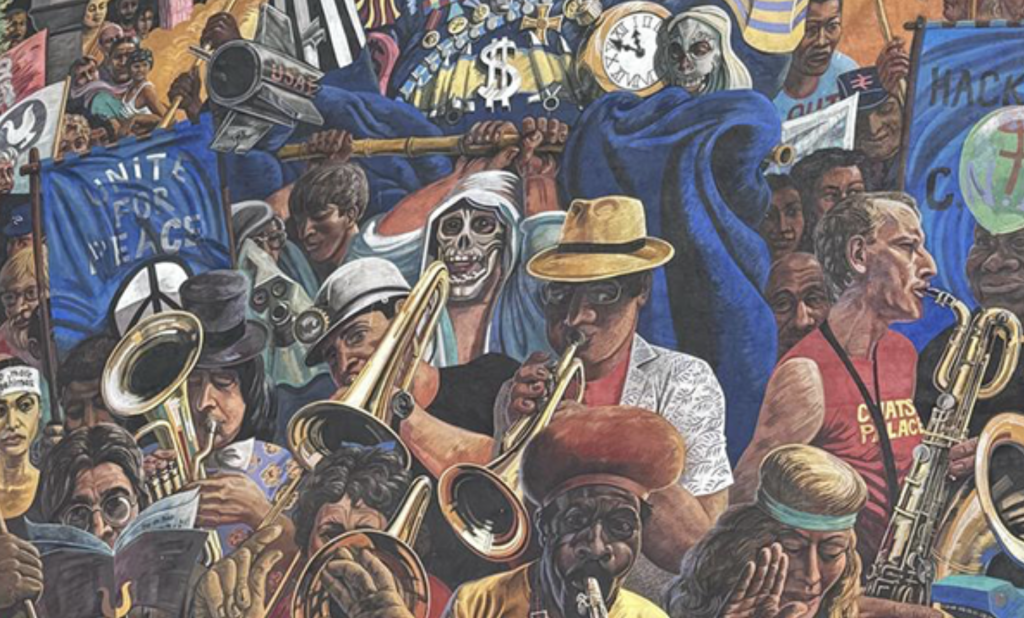
The most persistent artivist form. Street art operates in public space — it cannot be ignored, cannot be behind a paywall, cannot require an invitation. Its vernacular of graffiti letters, stencil imagery, and large-scale illustration creates visual disruptions in the urban fabric. The tradition runs from Rivera to Banksy to the BLM murals of 2020, adapting stylistically while retaining the fundamental democratic claim: this wall belongs to everyone.
Photomontage and appropriation
From Heartfield’s anti-fascist montages to Barbara Kruger’s text-over-image interventions (“Your body is a battleground”), the appropriation and recombination of existing images remains a core artivist technique. In the digital era, this has evolved into meme culture — the fastest-moving, most promiscuous form of image appropriation in history.
Performance and body art
The artist’s own body as medium — from the hunger strikes of suffragettes to Marina Abramović’s endurance performances to the die-ins of ACT UP — creates images of political witness with an immediacy that reproduced objects cannot match. The body cannot be dismissed as mere representation; it is presence.
Documentary and testimony
Photography and video that document injustice with aesthetic rigour — from Dorothea Lange’s Depression-era portraits to contemporary practitioners like Zanele Muholi, whose photographs of South African queer communities constitute both art and archive — occupy a crucial position in the artivist tradition.
Infographics and data visualisation
An increasingly significant artivist mode, weaponising data — about incarceration rates, climate metrics, wealth inequality, police killings — by translating it into visual form that bypasses statistical abstraction and produces visceral impact. The best political infographic is both aesthetically compelling and epistemically subversive.
Contemporary Issues: What Artvism Is Fighting Now
The contemporary artivist landscape is defined by urgency at an unprecedented scale. The crises demanding artistic response — climate breakdown, the global democratic recession, mass displacement, and the weaponisation of AI in information warfare — are not separate emergencies. They are interlocking features of a single systemic condition.
Palestine and the aesthetics of witness
The human suffering in Gaza has produced one of the most intense concentrations of artivist response in recent memory. Palestinian and international artists have taken to social media with visual work — posters, digital illustrations, murals — simultaneously memorialising the dead, demanding international accountability, and documenting ongoing atrocities as they occur.
Simultaneously, artists documenting the conflict have faced systematic suppression on major platforms. Instagram’s deletion of posts showing Palestinian casualties, criticised by human rights organisations as algorithmically enforced censorship, has forced a strategic reckoning: the same platforms that can amplify artivist work can also silence it. The response has been diversification — Substack, Patreon, artist-run websites, and physical distribution of printed materials — a return, in some ways, to pre-digital tactics, now running in parallel with online circulation.
Key figures to know
- Diego Rivera (1886–1957) Founding muralist; made socialist politics monumental.
- John Heartfield (1891–1968) Anti-fascist photomontage. Reproducibility as resistance.
- Barbara Kruger (b. 1945) Text-image interventions on gender, power, and capital.
- Guerrilla Girls (1985–) Anonymous feminist collective; data as weapon.
- Banksy Stencil art; media strategy as integral to the work.
- Zanele Muholi (b. 1972) Photography as archive of queer Black South African lives.
- Cannupa Hanska Luger (b. 1979) Indigenous practice; craft, ceremony, and media strategy.
- Ai Weiwei (b. 1957) Dissident practice under surveillance; institutional critique at scale.
The AI frontier: tool, subject, and adversary
Artificial intelligence represents both an extraordinary new tool for artivist practice and a profound new subject for artivist critique. Artists are using generative models to produce political imagery at scale, to create visual documentation where physical access is impossible or dangerous, and to generate counter-propaganda that exposes the mechanisms of disinformation.
At the same time, AI systems are themselves objects of artivist critique. The artists Holly Herndon and Mat Dryhurst have developed frameworks for understanding AI training on human cultural output as a form of labour extraction without consent. Spawning’s Have I Been Trained? tool — allowing artists to check whether their work was used to train image models — is itself a work of artivism: making visible a process of appropriation that its beneficiaries would prefer remain invisible.
The institution problem
Perhaps the most complex challenge facing contemporary artvism is the question of co-optation. When major institutions like the Tate, MoMA, the Venice Biennale embrace artivist practice, does the work retain its critical force? When corporate brands adopt the visual language of protest (Nike’s use of Colin Kaepernick’s image; the co-option of feminist messaging by fast-fashion companies), does activist aesthetics become a form of political sedation rather than political challenge?
There are no clean answers. The institutionalisation of artvism can extend the reach and resources of individual artists while dulling the radical edges of their practice. The Guerrilla Girls’ presence in MoMA’s permanent collection is both a vindication and an irony the institution they pilloried now curating their critique. This is not a problem to be solved so much as a tension to be navigated, work by work, decision by decision.
What remains constant, across every variation of context and medium, is the fundamental artivist wager: that aesthetic experience can alter consciousness, and altered consciousness can change the world. In an era of pervasive misinformation, algorithmic polarisation, and political despair, the bet is harder to make and more important to make than ever.