The True Pioneers of Pop Art
Britain’s Forgotten Vanguard: How a Ragtag Group of London Intellectuals Invented the Future of Art – a decade before New York took the credit
Long before Andy Warhol silkscreened his first Campbell’s soup can, before Roy Lichtenstein borrowed the grammar of comic books, and long before “Pop Art” entered the cultural lexicon as shorthand for a brash American phenomenon, a group of British artists, architects, and critics were huddled in the basement of the Institute of Contemporary Arts in London, arguing furiously about the meaning of jet engines, pulp magazines, and Hollywood film posters. It was here, in the austere, bomb-scarred city of postwar Britain, that Pop Art was truly born — not in the neon abundance of New York, but in the grey, rationed hunger of a nation only just beginning to imagine prosperity.
The story of British Pop Art is one of the great misattributions in cultural history, and it deserves to be told properly.
The Independent Group: Where It All Began
In 1952, a loose constellation of thinkers began gathering informally at the ICA on Dover Street. They called themselves the Independent Group, and they were unlike any artistic movement that had come before. Their membership included painters, sculptors, architects, designers, and critics — people with no shared style and every shared obsession. That obsession was the mass-produced image: advertising, science fiction illustration, car design, Hollywood glamour, military technology, and the seductive visual language of American consumer culture flooding into postwar Britain through magazines, films, and imported goods.
Britain in the early 1950s was a place of deep austerity. Rationing of some foods did not end until 1954. Against this backdrop of scarcity, the glossy American magazine — Life, Look, Esquire — arrived like a dispatch from another planet. These publications were not merely entertainment; they were evidence of a world in which industrial capitalism had produced something extraordinary: a visual culture of dazzling, democratic abundance. The Independent Group did not simply admire this. They interrogated it, celebrated it, and elevated it to the status of fine art.
Eduardo Paolozzi: The First Cut
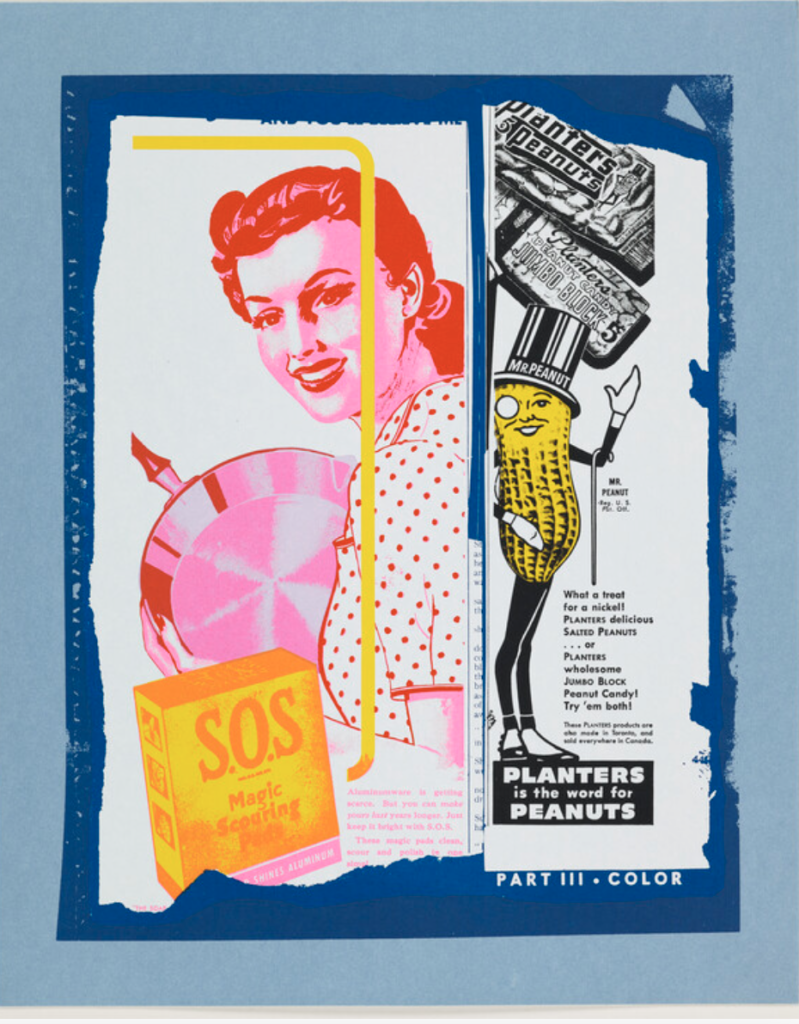
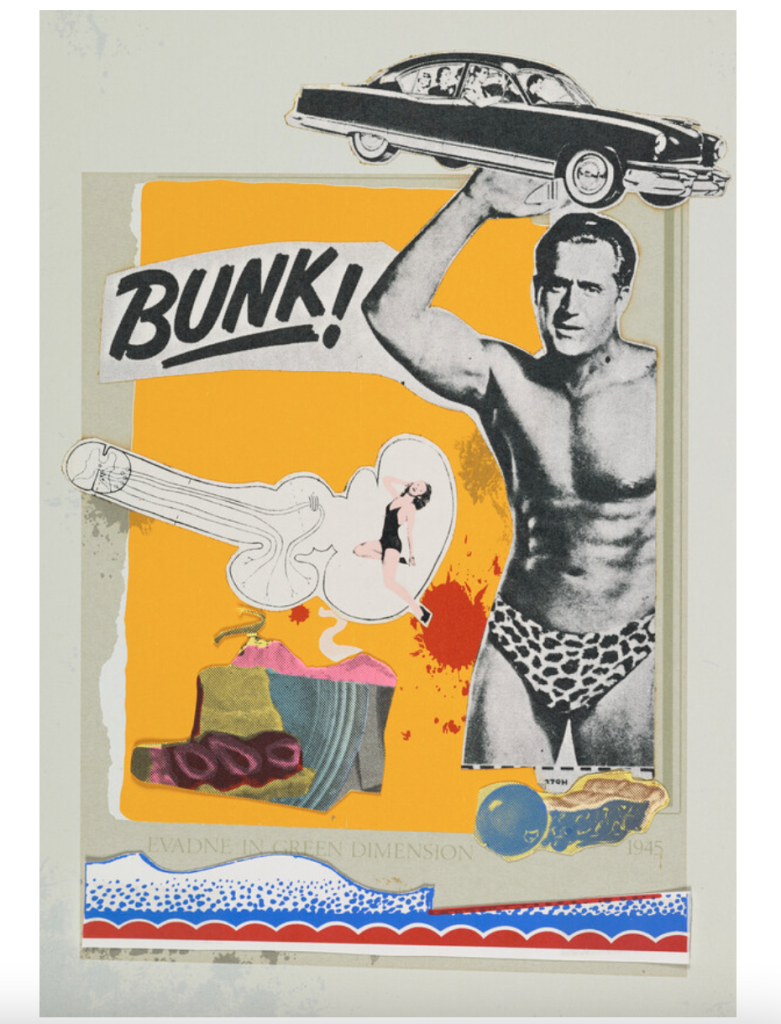
If one figure deserves the title of Pop Art’s true originator, it is the Scottish-Italian sculptor Eduardo Paolozzi. In February 1952 — before the Independent Group had even formally convened — Paolozzi delivered what is now recognised as the first Pop Art lecture in history, presenting a series of collages he called Bunk! to a small audience at the ICA using an epidiascope projector.
Bunk! was a revelatory act of creative vandalism. Paolozzi had been collecting American magazines and advertisements since the late 1940s, cutting out images of robots, rockets, Coca-Cola bottles, bodybuilders, automobiles, and celebrities, and assembling them into dense, vertiginous collages. In works such as I Was a Rich Man’s Plaything (1947) — which features, among other things, a cherry pie, a Coca-Cola logo, and the word “POP!” bursting from a pistol — Paolozzi invented the visual vocabulary of the movement a full decade before New York claimed it.
Paolozzi’s genius lay in his refusal to distinguish between high and low culture. The machine and the body, the sublime and the absurd, the sacred and the commercial — all of it was source material. His later bronze sculptures, monumental yet strangely tender, carried this same democratic instinct into three dimensions. He saw no hierarchy in the image-world; everything was equally fascinating, equally available, equally worthy of art’s attention.
Richard Hamilton: The Man Who Named the Thing
If Paolozzi lit the fuse, Richard Hamilton provided the detonation. In 1956, Hamilton contributed a small collage to the landmark This is Tomorrow exhibition at the Whitechapel Gallery, a collaborative show involving sixteen teams of architects, painters, and sculptors. Hamilton’s piece — Just what is it that makes today’s homes so different, so appealing?— became one of the most reproduced and debated images in twentieth-century art.
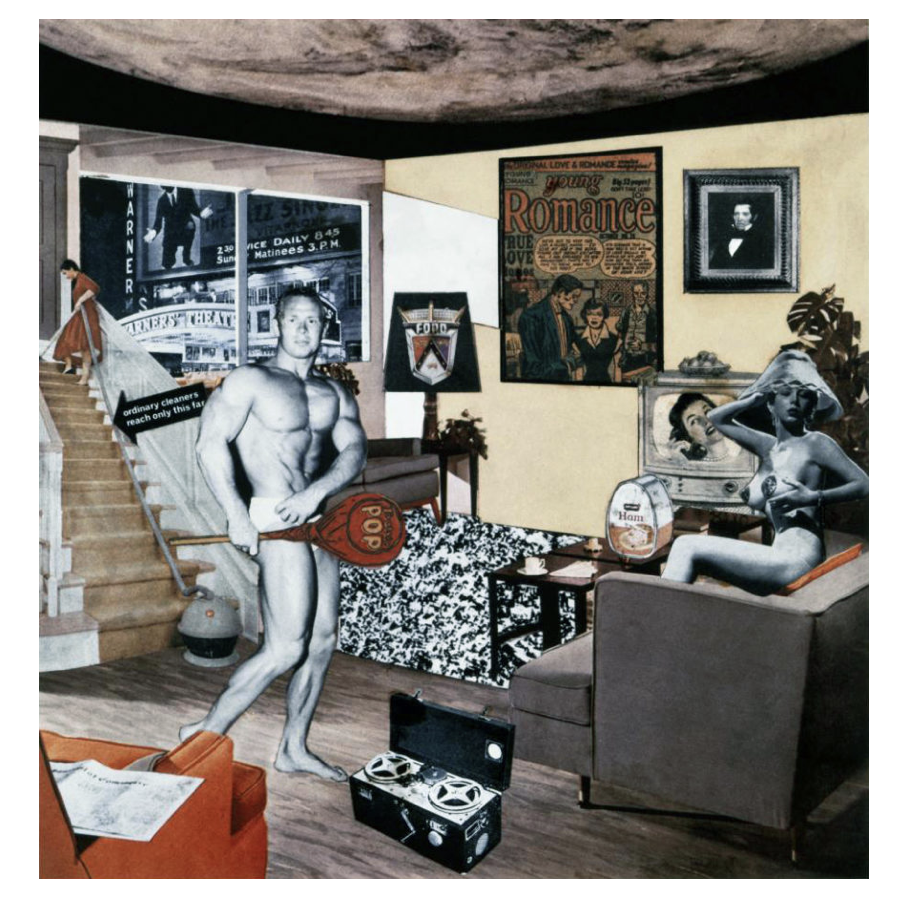
The collage depicts a domestic interior populated by the icons of consumer modernity: a bodybuilder holding a giant lollipop bearing the word “POP”, a pin-up on the sofa, a television, a tin of ham, a tape recorder, a vacuum cleaner, and through the window, a cinema marquee. It is a vision of the modern home as a theatre of consumption, simultaneously satirical and seductive, critical and celebratory. In a single image, Hamilton captured the ambivalence that would define Pop Art at its most intelligent.
Hamilton was also the movement’s most systematic theorist. In a letter written in 1957, he offered what remains one of the sharpest definitions of the Pop sensibility, describing the new art as: “popular, transient, expendable, low-cost, mass-produced, young, witty, sexy, gimmicky, glamorous, and Big Business.” This was not a manifesto of opposition to mainstream culture; it was a proposal to absorb it entirely, to turn the energy of advertising and entertainment against itself and in doing so reveal its hidden poetry.
Hamilton’s subsequent career elaborated this vision with extraordinary precision. His paintings — meticulous, cool, technically dazzling — treated the surfaces of modern life with the reverence usually reserved for Old Masters. He painted cars and interiors, fashion and politics, Marilyn Monroe and the Beatles, always with the same quality of intelligent, slightly amused attention.
Peter Blake: The People’s Painter
Where Paolozzi and Hamilton approached popular culture with the analytical instincts of the intellectual, Peter Blakeapproached it with the unguarded affection of a true fan. Blake was, in the most generous sense, a collector: of wrestling programmes, fan magazines, badges, postcards, and fairground ephemera. His studio was less a workspace than a cabinet of wonders, and his paintings had the same quality — dense, warm, almost archaeological accumulations of popular imagery.
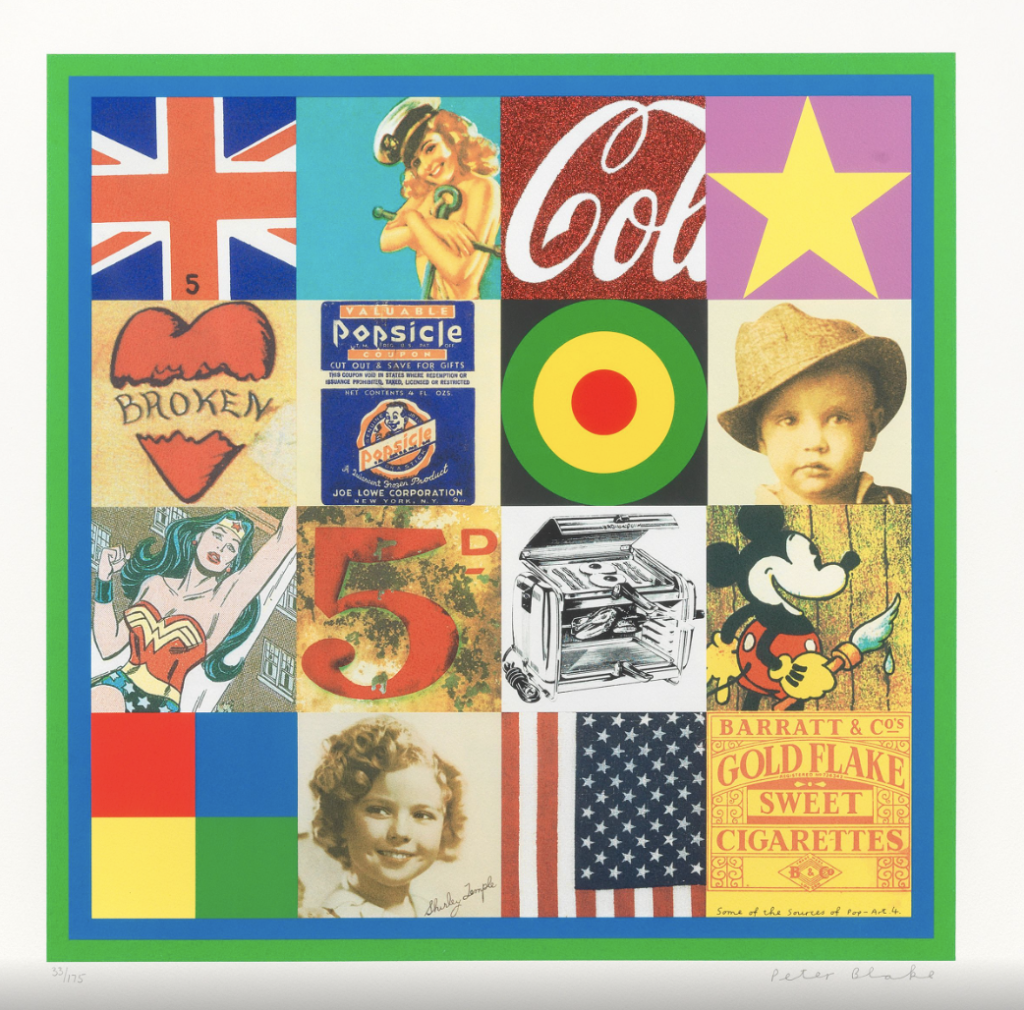
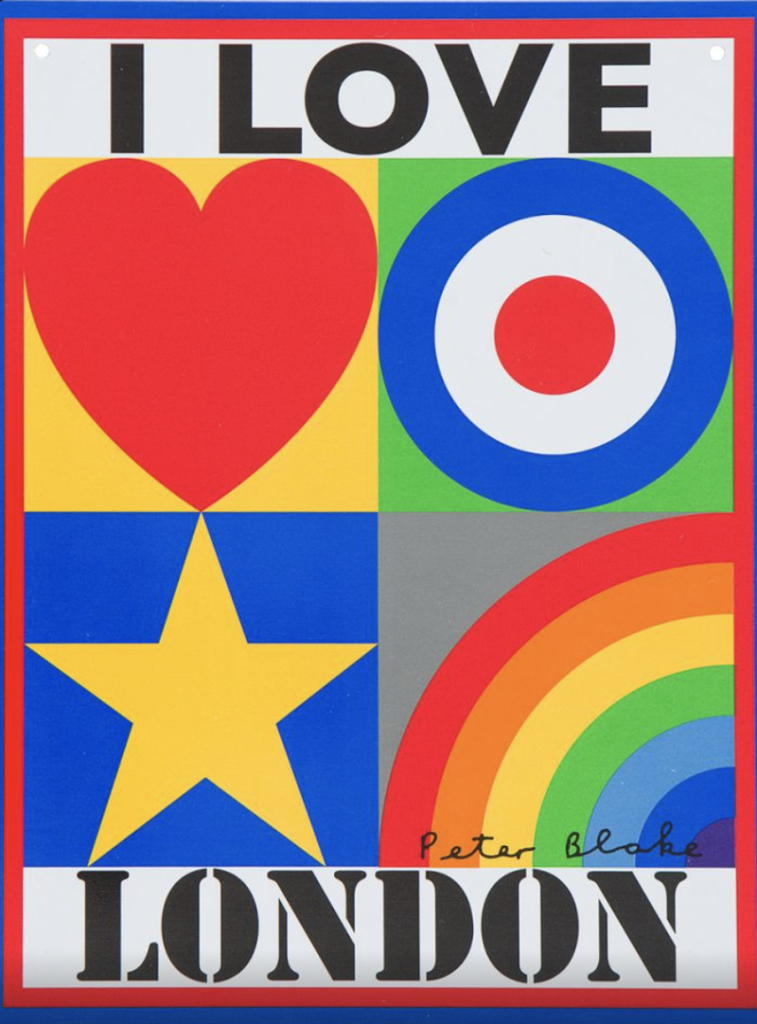
Blake’s work from the late 1950s and early 1960s is among the most immediately lovable in British art. Paintings like On the Balcony (1955–57) — begun while he was still a student at the Royal College of Art — pile up images of magazine covers, postcards, tins, and badges with the cheerful promiscuity of a schoolboy’s bedroom wall. There is nothing ironic here, no critical distance; Blake genuinely loved his subjects, and that love is what makes his work so enduringly warm.
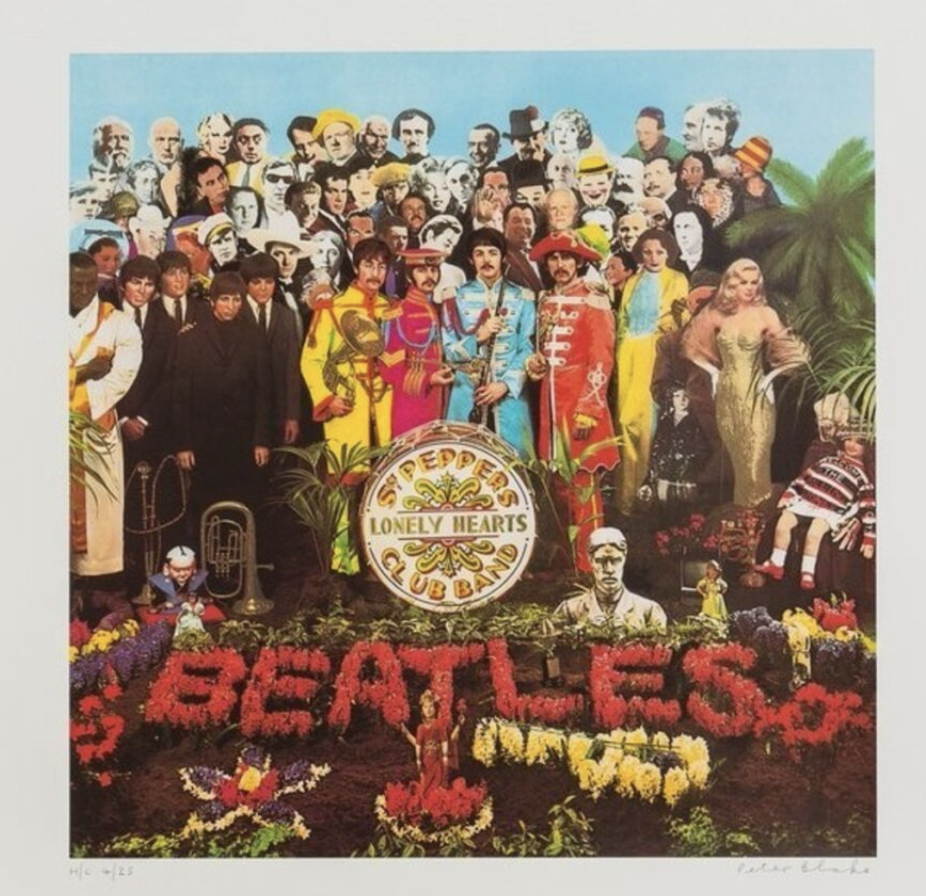
His most famous achievement — the sleeve design for the Beatles’ Sgt. Pepper’s Lonely Hearts Club Band in 1967, created with Jann Haworth — brought Pop Art to its largest audience yet, embedding it into the fabric of popular music and demonstrating, perhaps more clearly than any gallery exhibition could, that the boundaries between art and popular culture had collapsed entirely.
Blake’s contribution to Pop Art is sometimes undervalued precisely because of its accessibility. His work does not demand theoretical scaffolding; it rewards simply being looked at. But in this, he may have been the most radically democratic of the pioneers — an artist who believed that what the people loved was worth painting, not because it was ironic to do so, but because it was true.
The Overlooked and the Essential
The story does not belong to these three men alone. Nigel Henderson, a photographer embedded in working-class East London street life, fed the Independent Group with images of the everyday that challenged fine art’s pretensions to elevated subject matter. John McHale, who had spent time in America and returned laden with magazines and an almost missionary fervour about consumer culture, was instrumental in shaping the group’s thinking. Alison and Peter Smithson, the architects, explored how mass production and popular imagery might transform not just the canvas but the city itself.
Together, these figures constituted something that had never quite existed before: an avant-garde that was, paradoxically, populist. They did not retreat into abstraction or the hermetic gestures of the European avant-garde; they moved towards the crowd, towards the advertisement, towards the shop window and the cinema screen. They insisted that these were the truly contemporary subjects that any art which turned its face from the mass-produced image was turning its face from the world.
Why America Got the Credit
The reasons for the historical misattribution are not difficult to understand. When the American Pop artists emerged in the early 1960s (with the road partially paved by the above artists) , figures like Warhol, Lichtenstein, Jasper Johns, Robert Rauschenberg, they did so in the context of the world’s most powerful art market, with the full promotional apparatus of New York’s galleries and critics behind them Their work was louder, larger, and more commercially successful. It arrived in a country where consumer culture had already achieved the total saturation the British artists had only imagined.
The British origins of Pop Art were, for decades, treated as a footnote — an interesting precursor rather than the thing itself. Recent scholarship and a series of major retrospective exhibitions have begun to correct this, restoring the Independent Group to their rightful place at the origin point of one of the twentieth century’s defining movements.
The Legacy
Pop Art changed everything: the relationship between fine art and commercial design, the status of the found image, the permissible subjects of serious artistic attention, and the very idea of what an artist could be. It abolished, once and for all, the comfortable distinction between culture and Culture.
That revolution began not in the Factory, but in a basement in London, among a group of people who looked at a glossy American magazine and saw, glittering within it, the future of art. Their names deserve to be spoken first.
Further reading: David Robbins (ed.), The Independent Group: Postwar Britain and the Aesthetics of Plenty (1990); Marco Livingstone, Pop Art: A Continuing History (1990); Christoph Grunenberg & Max Hollein (eds.), Summer of Love: Art of the Psychedelic Era (2005).