The Heavenly Gaze: Andrei Rublev and the Transformation of the Sacred Image
Somewhere in early fifteenth-century Moscow, a monk grinds lapis lazuli into powder, mixes it with egg yolk and vinegar, and raises his brush toward a smooth linden board. In his understanding, it is not merely an act of craft; it is an act of theology. The monk is Andrei Rublev. The image he is about to set down will reorder everything that came before it.
To understand what Rublev achieved, we must first look back several centuries, to the workshops of Constantinople and the rigid, golden world from which Russian icon painting was born.
The Byzantine Inheritance — Icons Before Rublev
Origins of the Sacred Image
The icon — from the Greek eikon, meaning “image” or “likeness” — is among the oldest continuous art forms in Christian civilization. Its origins reach into the third and fourth centuries, when early Christians, operating in a visual culture saturated with Roman portraiture, began creating images of Christ, the Virgin, and the saints as objects of veneration rather than mere illustrations.
The theological weight of the icon was immense and contested. The Iconoclast Controversy (726–843 AD) tore the Byzantine Empire apart over the very question of whether sacred images were permissible. When the defenders of icons ultimately prevailed — the event is still commemorated in the Orthodox church as the “Triumph of Orthodoxy” — the icon was not viewed merely as devotional decoration but as a doctrinal statement: the incarnation of Christ made the divine visible, and to depict that visibility was an act of faith.
The Byzantine Aesthetic: God as Absolute
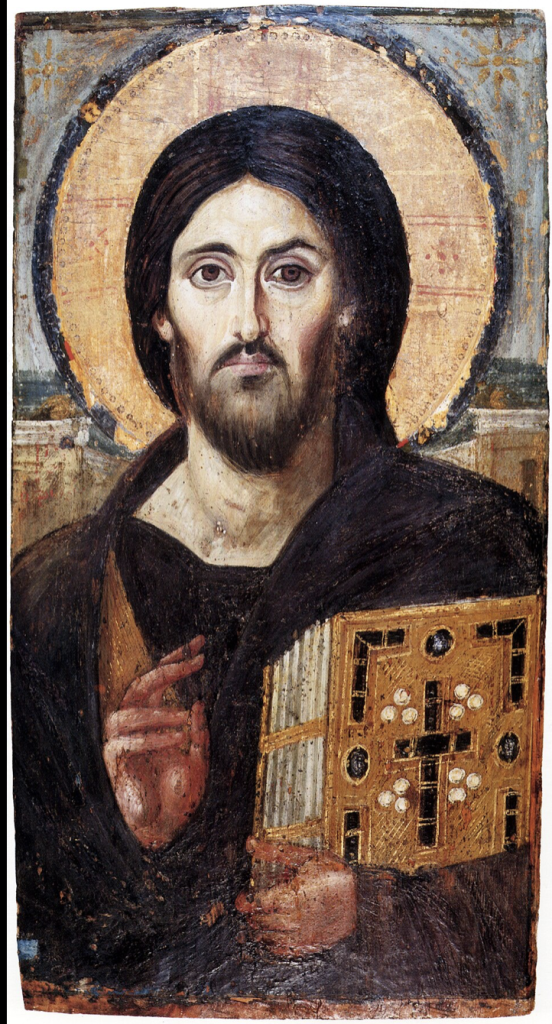
Out of this theological crucible emerged a visual language that would carry on for centuries. Byzantine icons of the ninth through the thirteenth centuries are among the most commanding objects ever made. Their power lies in deliberate, systematic transcendence of the natural world.
Figures are rendered flat, their bodies stripped of mass and volume. Faces are elongated, eyes enlarged, and fixed in a direct, frontal gaze that seems to pierce rather than observe the viewer. Drapery falls in schematic folds — abstract, rhythmic, unearthly — bearing no relationship to the nature and weight of cloth on a human body. Backgrounds are pure gold leaf, collapsing any sense of earthly space and time into the eternal present of the divine realm. Here, the gold is not just to illuminate; it represents the light.
The masterworks of this tradition — the sixth-century encaustic icons preserved at Saint Catherine’s Monastery on Sinai, the mosaics of Hagia Sophia, the great Theotokos images of Constantinople — are not attempting to depict a scene from this world. They are, in the theological language of the period, windows into heaven: points of contact between the created and uncreated.
Icon Painting as Liturgical Science
Byzantine icon production operated within a strict visual grammar. The podlinnik — a manual of iconographic rules — prescribed nearly every detail: the pose of a given saint, the colors of Christ’s robes (deep red over blue, signifying divine nature clothed in human flesh), the precise gesture of blessing hands. Deviation was not artistic license; it was error, potentially heresy.
Painters worked not as individual artists but as craftsmen in the service of an established religious tradition. Their names were rarely recorded. The image mattered; the maker was incidental.
This tradition migrated north as Christianity spread into Kievan Rus’ in 988 ( the first East Slavic state and later an amalgam of principalities in Eastern Europe from the late 9th to the mid-13th century). Byzantine artists traveled to Kiev, Novgorod, and eventually Moscow, bringing their materials, techniques, and their theology. For several centuries, Russian icon painting remained a provincial branch of Byzantine production, reverent, technically accomplished, and stylistically dependent.
Then came Rublev.
The World That Made Rublev
Andrei Rublev was born around 1360, into a Russia still deeply traumatized by the Mongol invasion of 1237–40, which destroyed its greatest cities and severed its connections to Byzantium. The Moscow that emerged from this catastrophe was politically fragile and spiritually hungry, a society rebuilding itself around the monastery and the church.
The dominant cultural force of Rublev’s youth was the hesychast movement, a mystical tradition originating in the monastic communities of Mount Athos in Greece. Hesychasm taught that through contemplative prayer — interior stillness ( hesychia )- that through deep inner quietude, they can behold the Uncreated Divine Light ( the light the apostles witnessed during the Transfiguration of Christ)
Rublev entered the Trinity Monastery near Moscow, founded by the great hesychast spiritual leader Sergius of Radonezh (1314–1392). Sergius was perhaps the most important figure in fourteenth-century Russia, credited with unifying the fractious Russian princes against the Mongols and with bringing spiritual life into a devastated culture. His theology was Trinitarian and contemplative, centered on the mutual love of the three Persons of the Trinity as the model for all human community.
Rublev absorbed this world utterly. When he eventually raised his brush, it was this theology of light, love, and divine mutuality that guided his hand.
The Revolution in Paint
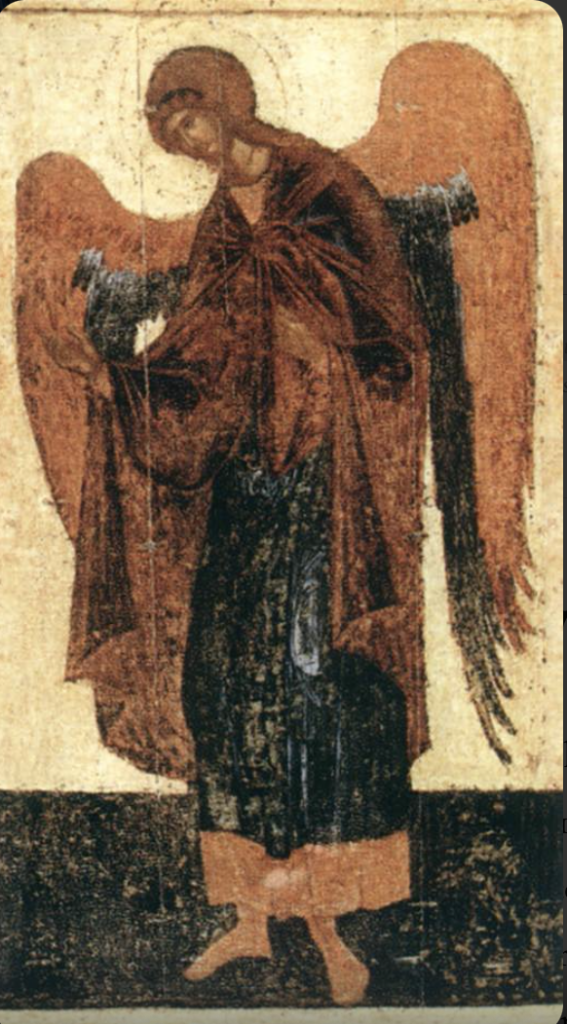
The first thing that strikes a viewer encountering Rublev’s work after studying earlier Byzantine icons is something difficult to name precisely — a quality of presence that is simultaneously more human and more luminous. The rigid frontality relaxes. Figures incline toward one another. There is interiority.
This was not sentimentality or naturalism in the Western Renaissance sense. Rublev had no interest in depicting musculature, shadows, or in placing figures within a recognizable landscape. He remained, in all essential ways, within the Byzantine tradition. But he inflected it with something new: tenderness.
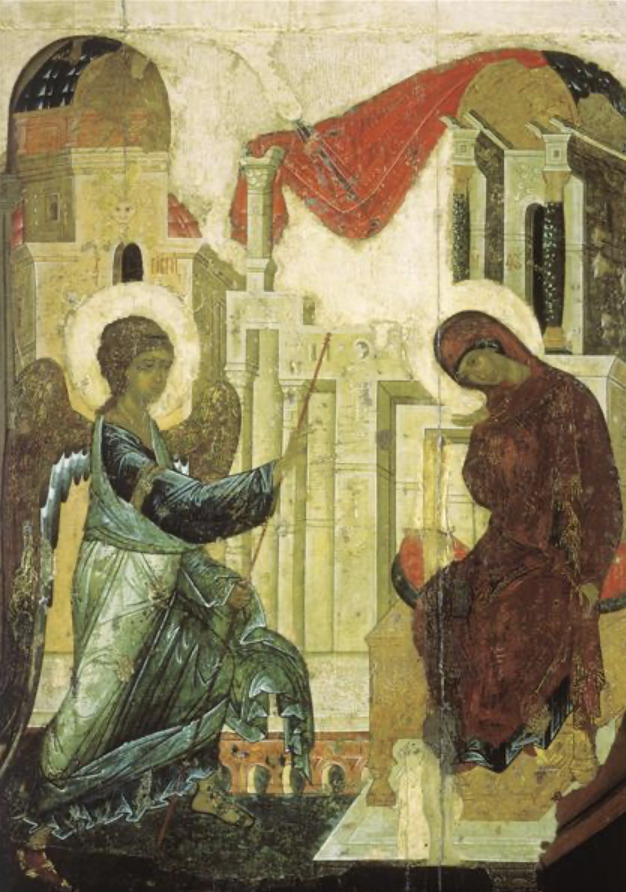
His faces, visible in surviving fragments from the Cathedral of the Annunciation in the Moscow Kremlin, painted around 1405, have a strong feeling of inward meditation. The eyes of the figures do not confront; they contemplate. The elongation of Byzantine conventions remains, but the figures are more humane; they breathe.
Color as Theology
Perhaps Rublev’s most radical innovation was his use of color. Byzantine icons, for all their magnificence, tend toward heavy, saturated, almost oppressive chromatic weight — deep ochres, dark greens, intense crimsons against the dominant gold. The gold ground was the source of all radiance; the pigments themselves were anchoring, earthbound.
Rublev inverted this relationship. His palette is luminous. His blues are celestial, shot through with an inner glow. His greens suggest spring, new life, the Hesychast’s “uncreated light” made visible on the painted surface. His use of white and near-white passages creates effects of internal illumination — as if the figures are not reflecting light but originating it.
This was a theological statement, not just an aesthetic one. In hesychast teaching, the saints and angels are themselves transfigured by divine light; they participate in it, become transparent to it. Rublev’s colors embody this doctrine: the figures are not lit from outside — they are the light.
Geometry and Grace
Rublev brought an extraordinary geometric sensitivity to his compositions. Where earlier icons often feel additive — figures placed side by side, each commanding its own space — Rublev constructs unified pictorial architectures in which the arrangement of forms carries meaning.
This is nowhere more evident than in his treatment of the Trinity, where circular and triangular geometries rhyme and echo across the panel, forming a sense of eternal motion and mutual inclusion.
The Trinity — The Icon of Icons
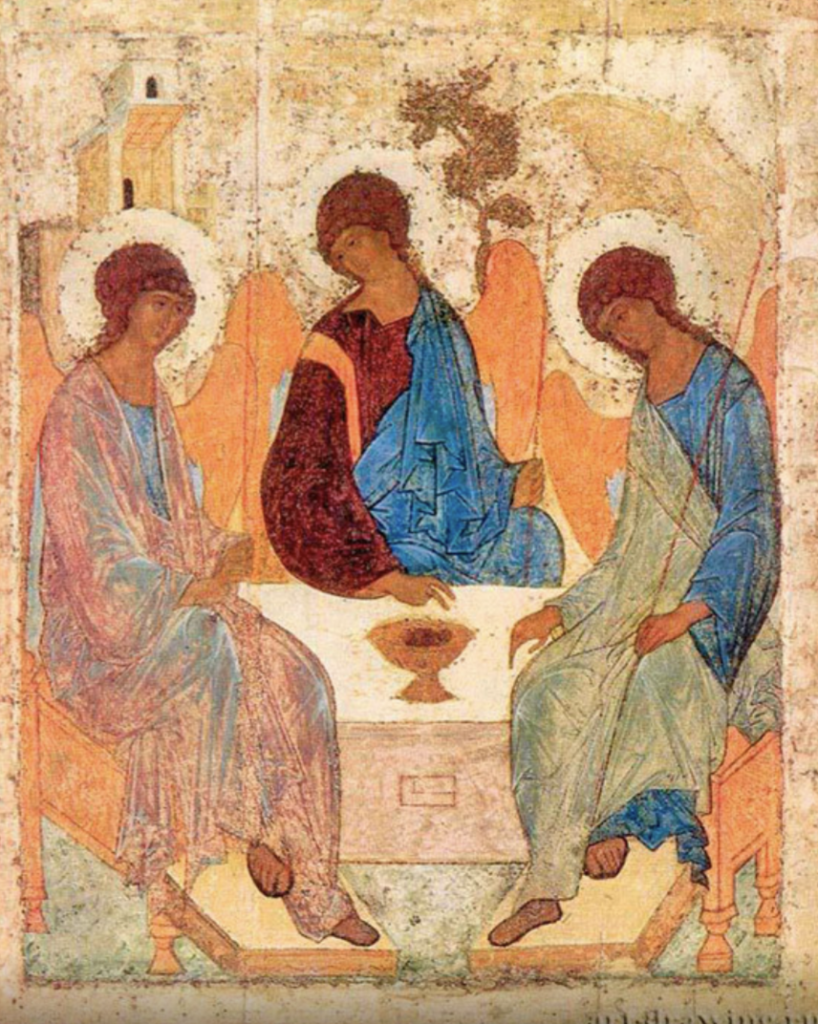
Around 1411, or possibly the 1420s — scholars debate — Rublev was commissioned to paint an icon for the iconostasis of the Trinity Cathedral at Sergius’s monastery, in memory of Sergius himself. The result is the Trinity (Troitsa), recognized as perhaps the greatest single icon ever painted.
The subject is the visit of three angels to Abraham at the oak of Mamre (Genesis 18), long interpreted by Christian theology as a prefiguration of the Trinity. Rublev inherited an iconographic tradition for this scene; earlier Russian and Byzantine versions of the Trinity typically included Abraham and Sarah in attendance, A tent, an oak tree, and the slaughtered calf. Rublev stripped it all away.
What Rublev Did
What remains in Rublev’s Trinity is elemental: three angels, a table, a chalice. The oak of Mamre has become a single slender tree. The mountain behind is almost abstract. All narrative detail, all anecdotal clutter, has been removed in the service of pure theological contemplation.
The three angels — representing the Father, Son, and Holy Spirit — sit in a loose circle around a table on which rests a chalice containing what appears to be a sacrificial lamb: the Eucharist, the sacrifice of the Son, already accomplished in the eternal councils of the Trinity before the creation of the world. Their heads incline gently toward one another and, at the same time, toward the chalice. Their forms are long and weightless, their robes luminous in Rublev’s characteristic blues, mauves, and greens.
What is almost miraculous is the sense of conversation, of relationship, of love in motion between the three figures — without a single naturalistic gesture. The circle of their arrangement draws the viewer into its center, into the space towards the chalice, into the mystery itself. There is an opening in the front of the table, a space left for the viewer, as if the painting is an invitation rather than merely an image.
The gold of the earlier tradition has retreated. The light now comes from within the figures themselves.
Contemporaries understood immediately that something unprecedented had occurred. The Moscow Council of 1551, the Stoglav (“Hundred Chapters”), specifically cited Rublev’s Trinity as the authoritative model to be followed by all Russian icon painters.
The Other Works
The Trinity tends to overshadow Rublev’s wider output, but the surviving fragments show a consistent genius at work.
His collaboration with the older master Theophanes the Greek on the Annunciation Cathedral frescoes (1405) shows Rublev already in full command of his idiom, his figures distinguishable from Theophanes’s more dramatic Byzantine manner by precisely that quality of luminous inwardness. Where Theophanes paints power and majesty, Rublev paints stillness and light.
The frescoes at the Cathedral of the Dormition in Vladimir (1408), painted with his close colleague Daniel Cherny, include a remarkable Last Judgment in which the usual terrors of damnation are subordinated to the radiant welcome of paradise — a theological emphasis entirely in keeping with Rublev’s hesychast formation. His saints move toward the light; they lean into it; they are it.
The Measure of the Revolution
What did Rublev actually change?
He did not abandon the Byzantine tradition. He did not introduce Western perspective or naturalistic anatomy. He did not paint from life or seek individual expression in any modern sense. By most technical measures, his work is a continuation of what preceded it.
What he changed was the inner climate of an image. Byzantine icons in their severity speak of a God who is absolute, transcendent, beyond reach — to be feared and approached with prostration. Rublev’s icons speak of a God who leans forward, who makes room, who in the mystery of the Trinity exists as an eternal exchange of love that is, astonishingly, open to human participation.
This is a theological shift of the first order rendered entirely in paint. It required not a rejection of the tradition but its deepest possible internalization — and then a transfiguration from within, using the hesychast doctrine of divine light as the catalyst.
Later Russian icon painting would largely fail to sustain what Rublev achieved. The fifteenth century produced some remarkable work in his wake — Dionysios is the most notable heir — but the tradition would gradually harden into repetition, and by the seventeenth century, Western Baroque influences would begin to compromise the icon’s essential character.
Rublev stands, therefore, not only as the peak of Russian medieval art but as one of the most complete fusions of theological thought and visual form in the history of human image-making. He did not illustrate a doctrine. He made the doctrine visible — and in doing so, gave it a new face: serene, luminous, and indefinably kind.
Rublev was canonized by the Russian Orthodox Church in 1988, a millennium after the Christianization of Rus’. It is a fitting symmetry. The tradition that began with Byzantine missionaries and their golden panels, their frontal gazes and their absolute God, reached its fullest flower in the hands of a Moscow monk who looked at all that severity and, without discarding a single theological truth, found in it a quality of grace the tradition had always contained but never quite, until then, fully shown.
Further Reading: Victor Lazarev, Andrei Rublev and His School (1966); Leonid Ouspensky & Vladimir Lossky, The Meaning of Icons (1952); Gabriel Bunge, The Rublev Trinity (2007)