How Instagram Killed the Ratio
A century of photographic tradition — from Oskar Barnack’s Leica to the Hasselblad on the moon — dismantled by a Silicon Valley app and a generation raised on smartphone screens.
PHOTOGRAPHY & CULTURE · VISUAL HISTORY
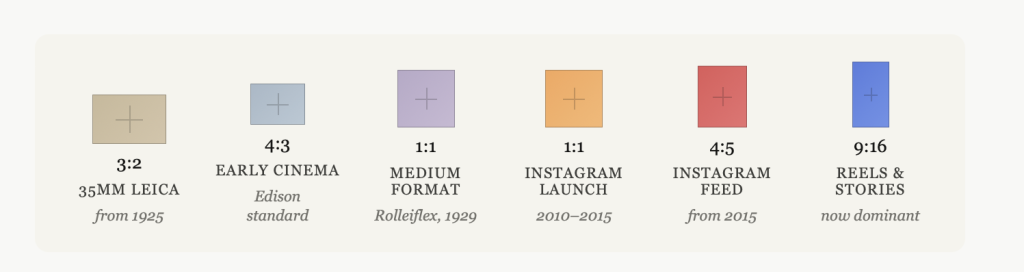
In the winter of 1913, a young German engineer named Oskar Barnack sat in a workshop at the Leitz optical factory in Wetzlar and solved a problem no one had quite articulated yet. Photography at the time was a matter of heavy plates, unwieldy cameras, and images that had to be large enough to be contact-printed. Barnack wanted to move. He was asthmatic, unable to carry a large plate camera on walks, and he had a vision: small negatives, enlarged to great images. What he did next, in that quiet workshop, quietly determined how human beings would frame the world for the next hundred years.
He took 35mm cinema film — the same perforated stock Thomas Edison’s company had standardized for the moving image — and ran it sideways through a prototype camera. Cinema frames measured 18 by 24 millimeters. By running the film horizontally, Barnack doubled the frame size to 24 by 36 millimeters. The arithmetic is simple: 36 divided by 24 equals 1.5. The 3:2 aspect ratio was born — not from aesthetics, not from a study of the golden section, but from a practical act of doubling. Barnack called his prototype the Ur-Leica. By 1925, when Leitz released the first commercial Leica, a proportion had been set that would define photographic vision for a century.
A century of careful rectangles
To understand what Instagram destroyed, you first need to understand what it destroyed. The 3:2 ratio of 35mm film is not arbitrary. It sits at a midpoint between the too-square and the too-wide — broad enough to accommodate landscape photography’s hunger for horizontal sweep, narrow enough to hold a portrait without the subject drowning in empty space. Generations of photographers trained their eyes to see within it. Compositional rules — the rule of thirds, the golden ratio, the diagonal — were all calibrated, consciously or not, to the 3:2 frame.
“Small negatives — large images.”
— OSKAR BARNACK, INVENTOR OF THE LEICA, ON HIS GUIDING VISION FOR 35MM
Meanwhile, a parallel tradition developed alongside the 35mm rectangle. In 1929, the German company Rollei introduced the twin-lens reflex camera — a device you held at waist height and looked down into, which made rotating to a vertical orientation deeply awkward. The solution was elegant: make the frame square. The 6×6-centimeter format, shot on 120 roll film, produced a 1:1 image that required no rotation. The Rolleiflex, as it came to be known, was adopted by the greatest photographers of the mid-twentieth century. Richard Avedon used one. Irving Penn used one. Diane Arbus used one. Vivian Maier used one. When Hasselblad came along in 1948 with its modular SLR system, it too chose the 6×6 square, and NASA sent modified Hasselblad cameras to the Moon. The square, in the hands of masters, was not a limitation. It was a statement of completeness.
THE MAJOR FILM FORMATS AT A GLANCE
35mm (24×36mm, ratio 3:2) dominated amateur and street photography. Medium format 6×6 (ratio 1:1) ruled professional studios. Large format 4×5 and 8×10 inch sheet film defined landscape and architectural work. Each format carried its own visual culture, its own cost, its own weight — and its own distinct sense of what a photograph should look like.
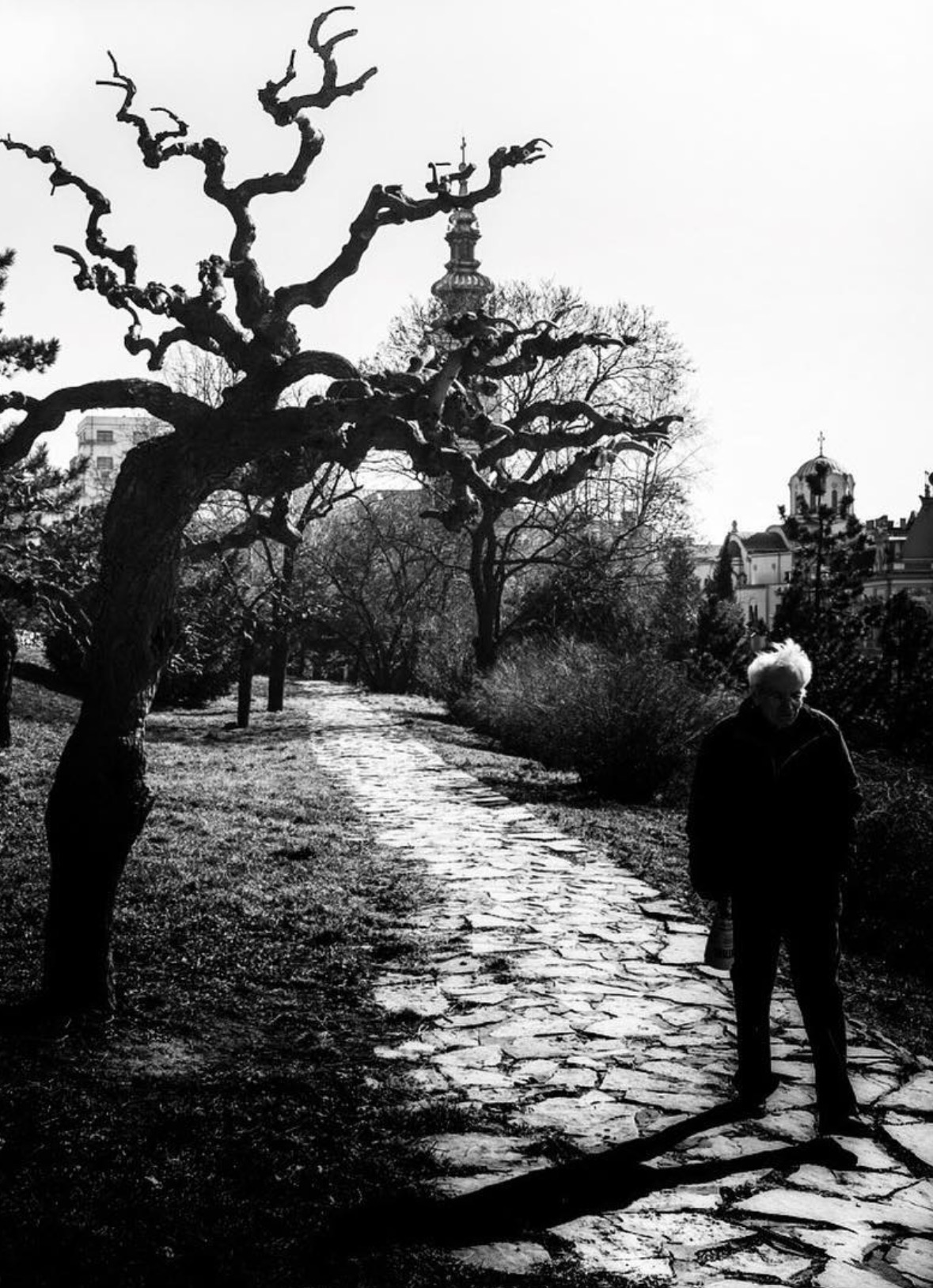
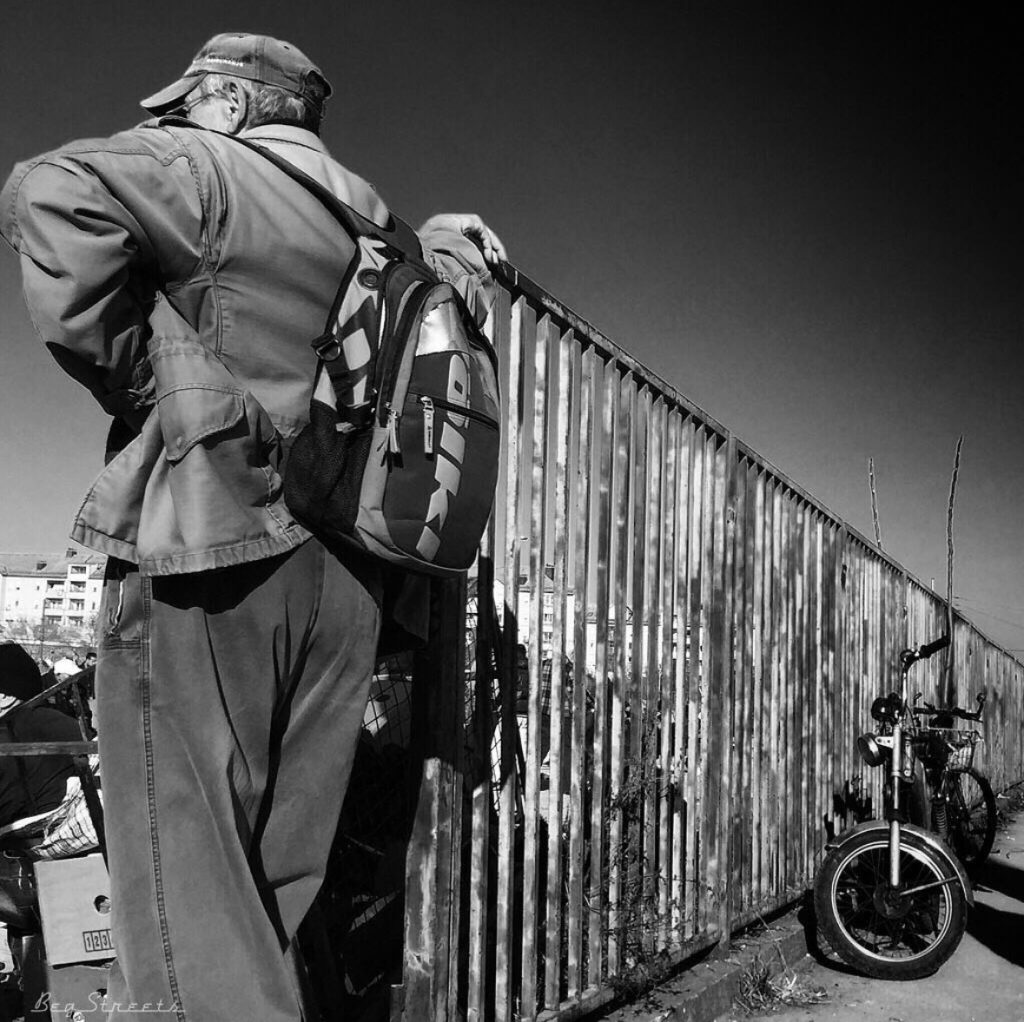
Large format cameras — shooting on 4×5 or 8×10 inch sheet film — occupied another register entirely. With their bellows, their ground-glass viewing screens, their tripods and dark cloths, they produced a ratio close to 5:4 and an image of almost supernatural resolution. Ansel Adams made his Zone System work on large format. Edward Weston photographed his peppers and shells and nudes on large format. The prints these cameras produced could be contact-printed at full size — no enlargement needed, no grain, just a tonal depth that the small negative could never match.
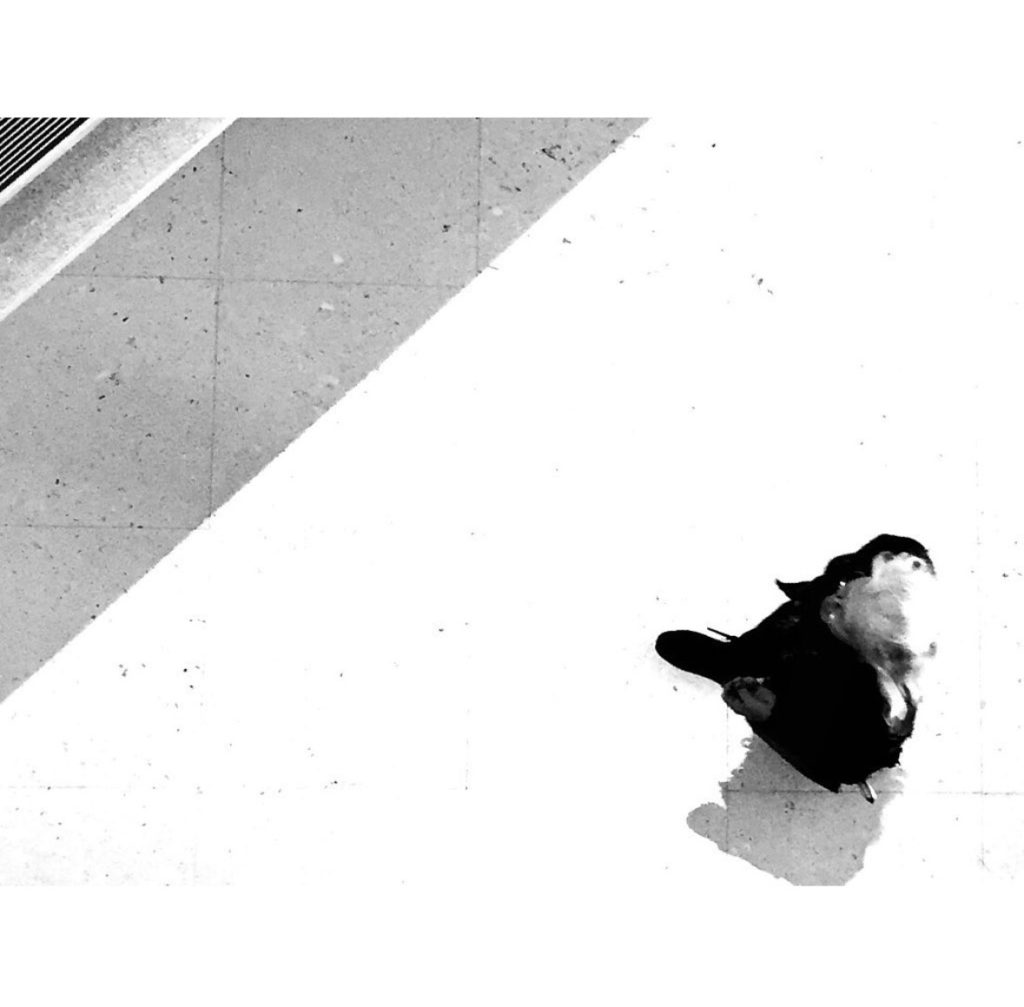
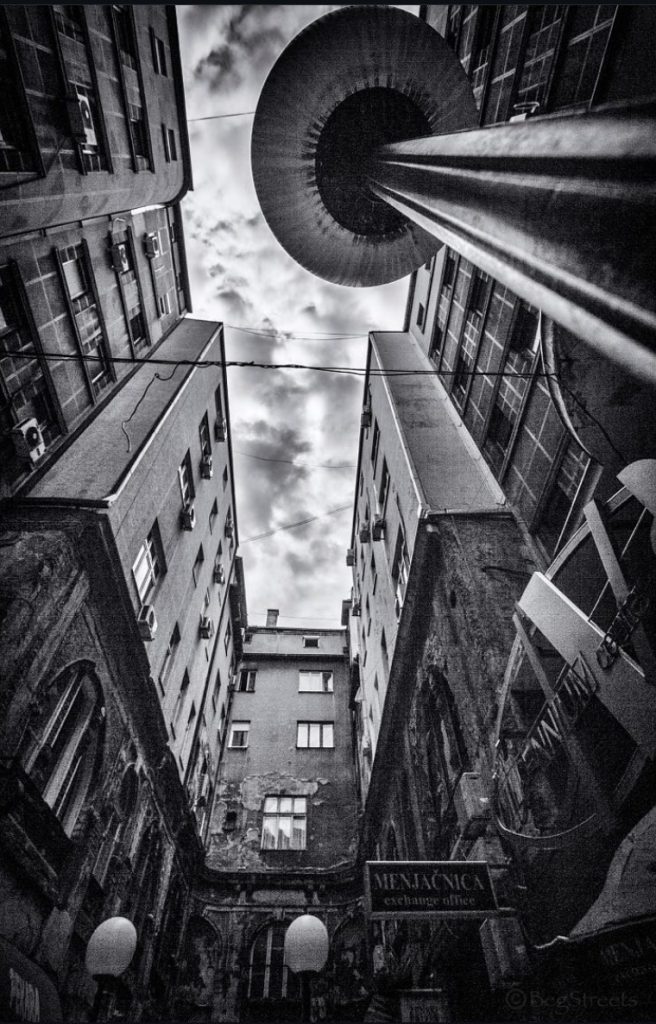
Each of these traditions — 35mm, medium format, large format — built up a century of compositional knowledge. Books were written about how to see within the 3:2 frame. Film stocks were developed with particular formats in mind. Print papers came in sizes calibrated to specific ratios. Darkrooms were engineered around them. Photography education was inseparable from the act of learning to see within a particular rectangle. The frame was not a constraint you worked around. The frame was part of the photograph.
October 2010: the small square arrives
Instagram launched on October 6, 2010, built around a single constraint that its founders Kevin Systrom and Mike Krieger borrowed — consciously or not — from the Polaroid Instamatic and the Rolleiflex tradition: every photograph must be square. The 1:1 ratio was enforced absolutely. Upload a landscape, and it was cropped. Upload a portrait, and it was cropped. The choice was stark: fit within the square or don’t post.
October 2010 – Instagram launches with a mandatory 1:1 square format. Every image — landscape, portrait, panorama — must be cropped to fit. The 3:2 ratio of 35mm photography simply does not exist on the platform.
August 2015 – Instagram relents. Landscape (1.91:1) and portrait (4:5) formats are now permitted. The 3:2 ratio of every DSLR and mirrorless camera is still not natively supported — users must crop or add black bars.
2016 -Instagram Stories launch, adopting the 9:16 vertical format that fills the smartphone screen entirely. A fundamentally new visual language — tall, fleeting, full-bleed — begins competing with the traditional feed.
2020 – Instagram Reels launches, doubling down on 9:16. The vertical video format, pioneered by TikTok, begins reshaping how an entire generation frames moving images.
January 2025 – Instagram changes its profile grid from square to portrait rectangles. Instagram head Adam Mosseri explains: “Most of what’s uploaded, both photos and videos, are vertical in their orientation.” The 1:1 era is formally over.
2025 – Instagram adds support for 3:4 portrait images — a ratio with no precedent in the history of film photography. The platform now hosts five different aspect ratios, none of them the 3:2 that defined a century of cameras.
The irony of Instagram’s original square format is that it was, in photographic terms, a defensible choice. The 1:1 ratio has a distinguished history. Arbus shot square. Penn shot square. The square forces a kind of centered, symmetrical attention that the rectangle tends to deflect. When Instagram imposed the square, a generation of young photographers — many of them encountering compositional thinking for the first time — learned to see within it. Entire aesthetic vocabularies formed around the Instagram grid: the flat lay, the centered portrait, the symmetrical architecture shot. The square, for five years, had its moment as the dominant visual language of popular photography.
“I know some of you really like your squares… but at this point, most of what’s uploaded, both photos and videos, are vertical in their orientation.”
— ADAM MOSSERI, HEAD OF INSTAGRAM, ANNOUNCING THE 2025 GRID CHANGE
The vertical revolution and what it costs
The deeper disruption came not with the abandonment of the square but with the rise of Stories and Reels. The 9:16 ratio — 9 units wide for every 16 units tall — is the exact inverse of the 16:9 widescreen format that cinema adopted in the 1990s. It is the shape of a smartphone held vertically, and nothing else. It has no precedent in the history of still photography. No camera, film or digital, has ever natively produced a 9:16 image. To shoot for Stories or Reels is to shoot for a format that the entire tradition of photographic composition has no language for.
This matters because the rules of composition were developed — over centuries, through painting as much as photography — for horizontal or near-horizontal frames. The rule of thirds assumes a landscape orientation. The horizon line, that fundamental anchoring element of landscape photography, becomes a vertical stripe in 9:16. The visual weight of a subject placed in the lower third of a 9:16 frame falls almost at the physical bottom of the image in a way that creates unease rather than balance. The aesthetic conventions that serious photographers spend years internalizing simply do not translate to the vertical slab.
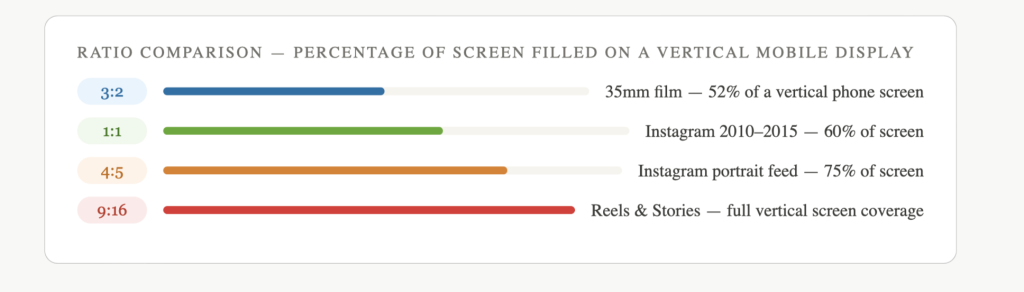
The platform’s logic is not photographic — it is attentional. Vertical content fills the screen. It leaves no surrounding feed visible to distract. It commands the eye by occupying all of it. The 9:16 ratio is not a compositional choice; it is an engagement metric dressed up as an aesthetic. Instagram’s own internal research, and the data of countless marketing studies, confirms that vertical content performs better on vertical screens. The algorithm rewards what the screen rewards. Photography was never consulted.
What a generation learned to see — and what it didn’t
The consequences are cultural as much as technical. An entire generation of young people has grown up with Instagram as their primary context for photography. For them, the 3:2 rectangle of a DSLR or mirrorless camera is the anomaly — the format that requires cropping before it can be shared. The square that Arbus loved, the widescreen panorama that Adams composed, the careful 3:2 rectangle that Cartier-Bresson considered an extension of his eye: all of these require the viewer to mentally adjust when encountered on a phone screen, where white bars appear at the top and bottom to letterbox an image that simply wasn’t built for the platform’s geometry.
Camera manufacturers have noticed. Fujifilm’s film simulation cameras now include 1:1 and various vertical formats as native shooting options. Mirrorless cameras display aspect ratio guides in the viewfinder, with 4:5 and 9:16 appearing alongside 3:2. Photography schools and workshops that once devoted entire seminars to horizontal composition now devote equal time to vertical framing. The camera has been asked to follow the phone, and it has largely agreed to do so.
WHAT WAS LOST IN THE CROP
When a 3:2 image is cropped to 1:1 for Instagram, approximately 33% of the horizontal information disappears. For a landscape photographer who spent an hour positioning the horizon perfectly within the frame, or a street photographer who needed the foreground and background in careful tension, that crop is not a minor inconvenience. It is the destruction of the photograph.
The frame was always a choice — until it wasn’t
There is an argument to be made that every change in photographic format is simply the continuation of a long history of formats in competition. The 3:2 ratio beat out the 4:3 of early cinema. Medium format’s 1:1 competed with 35mm’s 3:2 for professional supremacy for decades. Panoramic cameras produced ratios of 2:1 or wider. Photography has never had a single, sacred proportion. The argument has merit, as far as it goes.
What it misses is the relationship between the photographer and the frame. When Barnack doubled the cinema frame, he did so as a photographer thinking about what photography needed. When Rollei made the 6×6 square, they were solving a specific optical and ergonomic problem — and the photographers who adopted it did so knowing the constraint and building a practice around it. The formats that shaped photographic history emerged from within the discipline, from the logic of lenses and film planes and compositional tradition.
The 9:16 format of Instagram Reels emerged from a different logic entirely: the shape of a phone that fits in a pocket. The frame was not designed for photography. Photography was simply required to fit inside it. The distinction is not trivial. It is the difference between an art form that generates its own containers and an art form that has been asked to pour itself into someone else’s.
Oskar Barnack, in his Wetzlar workshop, was also constrained — by the width of cinema film, by the limits of the lenses available to him, by the needs of a portable camera. But the constraint he worked within was photographic from first principles. He was thinking about the negative, about the print, about light on film. The founders of Instagram were thinking about the grid. These are not the same thing, and photography will spend decades working out what the difference means.
The 3:2 aspect ratio remains the native format of every full-frame and APS-C digital camera sold today — a standard now over a century old. On Instagram, it requires cropping before it can be posted without letterboxing.
>>> Back to Articles