Giotto, The Man Who Reshaped Western Art
In the history of Western art, few revolutions announce themselves quietly. Most are loud, polemical, and documented in manifestos and counter-manifestos. But the revolution that Giotto di Bondone unleashed upon the world in the early fourteenth century was about painting human figures that seemed alive.
Before Giotto, the dominant visual language of European painting was Byzantine in spirit and manner: flat and stiff, gold-drenched, hieratic, built for contemplation rather than emotion. Holy figures floated against gilded light. Giotto inaugurated a luminous tradition that runs from Masaccio through Michelangelo, from Raphael through Caravaggio and beyond — the tradition of Western figurative painting as we still understand it today.
Born around 1267 in the Mugello valley north of Florence, Giotto di Bondone grew up in a modest farmland . Accounts of his early life are tangled with legend, most famously the story, repeated by Vasari with great relish, that the young shepherd boy was discovered by the master Cimabue while drawing a sheep on a flat stone. Whether true or not, the anecdote perfectly encodes what made Giotto extraordinary: the instinct for observation, the willingness to look at the world as it actually was.
What we know with confidence is that by the early fourteenth century, he had become the most celebrated painter in Italy. Dante, his near contemporary, immortalised him in the Purgatorio. If there is a single building in the history of Western art that demands to be understood as a turning point, it is the Scrovegni Chapel in Padua — known as the Arena Chapel — commissioned by the wealthy banker Enrico Scrovegni and decorated by Giotto between 1303 and 1306. Walking into it today, even through the controlled humidity of its painstaking preservation, is one of the most affecting experiences European art can offer.The walls are covered, floor to vault, with thirty-eight narrative scenes from the lives of the Virgin and Christ, interspersed with allegorical figures and a monumental Last Judgement on the entrance wall. But what most probably struck the first visitors in 1306 were the faces of the painted figures.
In the Lamentation, the body of the dead Christ is lowered toward the earth with angels in grief in the background. The mourners — Mary, Mary Magdalene, John the Evangelist — bend and huddle around the body with evident sorrow, expression physiological and real. Nothing in earlier European painting had prepared the eye for this. The grief is not just symbolic. It is happening, now, to living people, not icons.
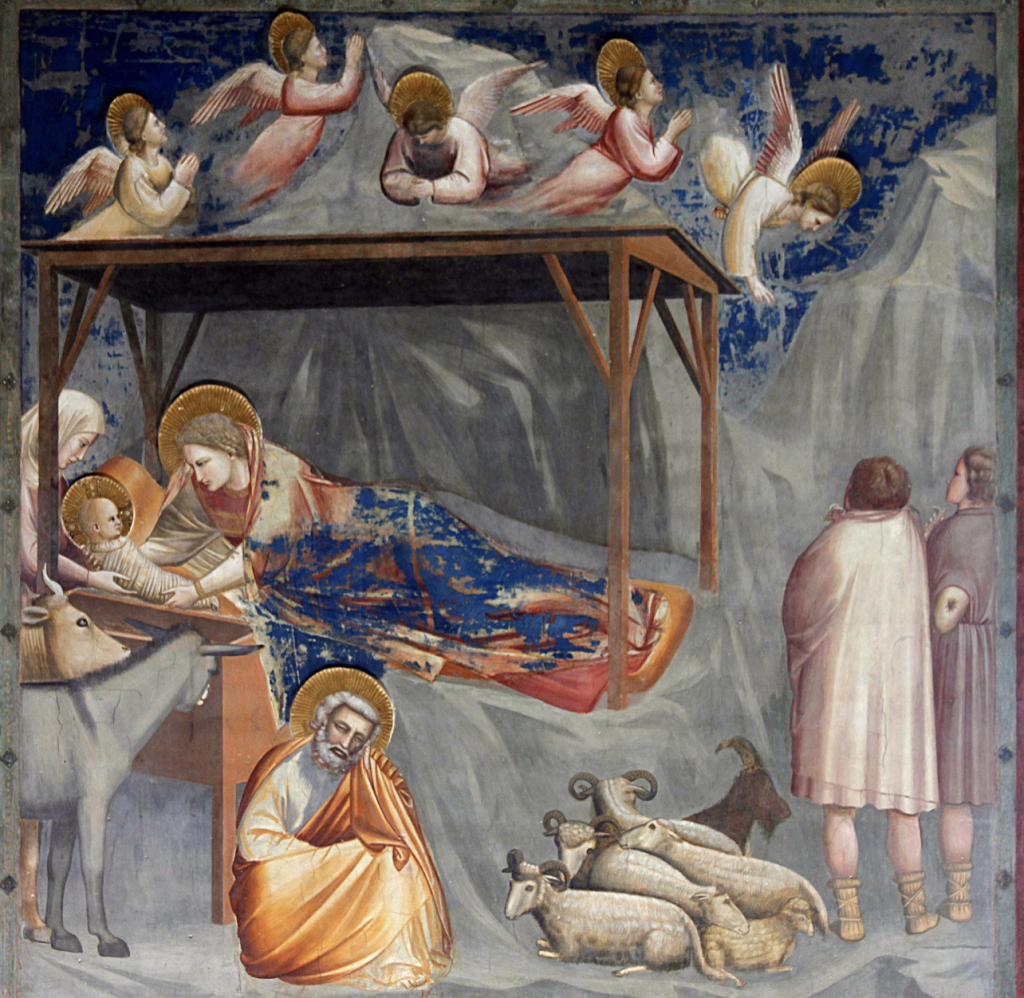
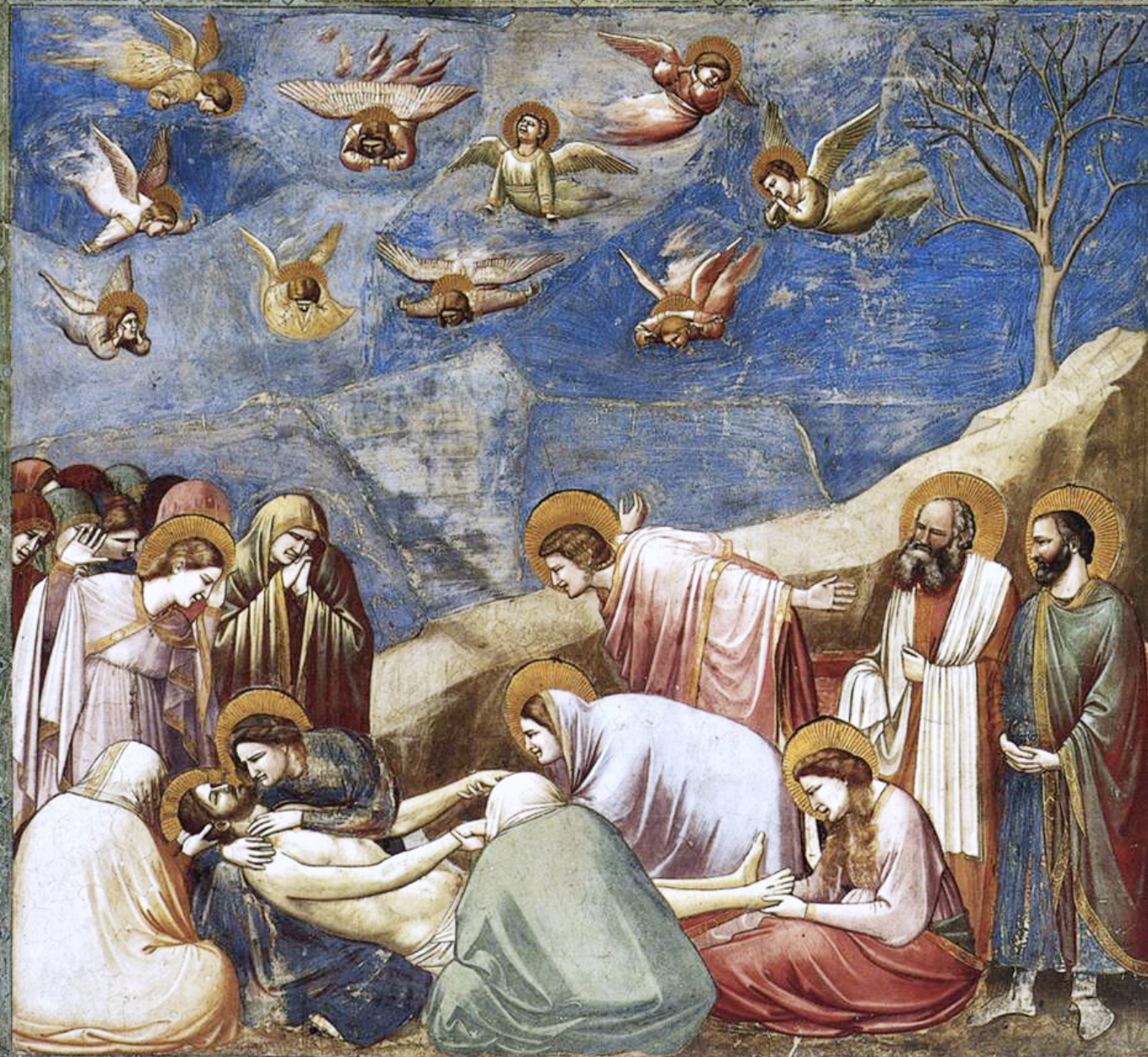
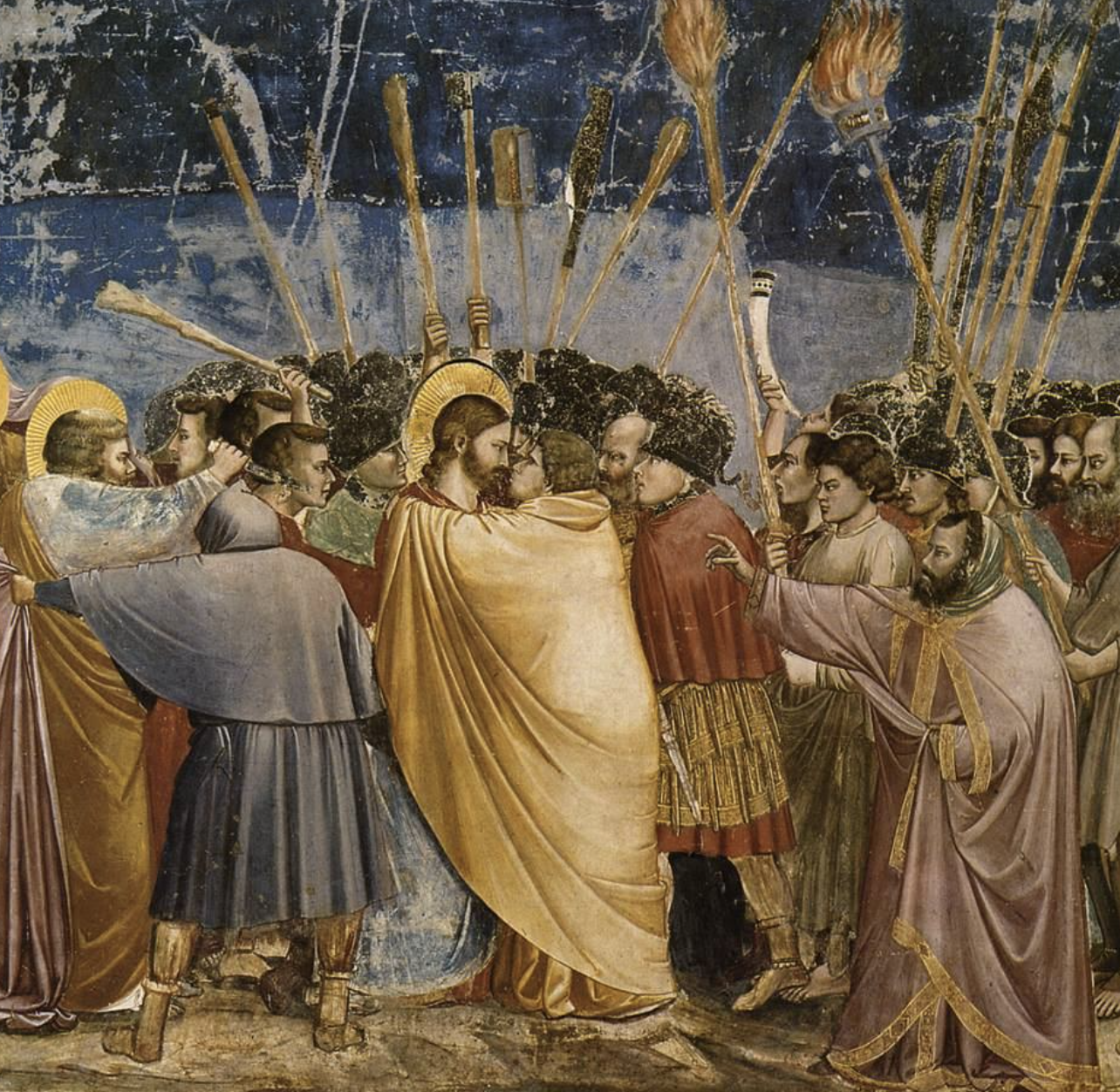
This was Giotto’s great invention: the representation of psychological space. His figures exist in three dimensions, cast shadows, react to one another, occupy a space in a recognisable architecture of cause and effect. Where Byzantine painting had organised the picture plane theologically with significant figures larger, divine light hovering above all, Giotto organised it humanly. Figures face each other. They argue, weep, look away in discomfort, or turn toward one another in recognition.
The Kiss of Judas and the Drama of the Gaze
No scene in the Arena Chapel concentrates this dramatic intelligence more powerfully than the Kiss of Judas. The scene is dense with figures — soldiers, torchbearers, priests — yet the eye moves towards the confrontation at its centre: the face of Christ meeting the face of Judas, the eternal facing the transient, stillness against the terrible momentum of betrayal. Giotto achieves this through the radical simplicity of the gaze. Christ looks directly at Judas. Not at the viewer, not towards heaven. He looks at the man who is about to kiss him. The theological drama becomes a human drama. This kind of depiction was unprecedented. And it would not be surpassed until a hundred years later, when Masaccio picked up where Giotto left off and began what we call the Italian Renaissance.
The Ognissanti Madonna: Volume on the Altarpiece
The Arena Chapel has sometimes made it too easy to think of Giotto purely as a fresco painter. But his panel paintings reveal the same revolution in miniature. The Ognissanti Madonna, now in the Uffizi, was painted around 1310 and was intended for the Ognissanti church in Florence. Set beside the great Madonnas of Cimabue and Duccio — both of which survive nearby in the same room, a confrontation museum visitors rarely forget — it is immediately, shockingly different.
The throne has weight. The angels surrounding it are crowded, pressing against each other, their positions in space legible and logical. Mary herself — monumental, solid, entirely unconvinced by the golden abstraction surrounding her — turns the painted surface into the surface of something that is almost like sculpture. Her lap holds the Christ child not as a symbol but as a real, heavy infant, and her hand rests against him with the unhurried authority of a mother. The gold of the Byzantine tradition is still there — halos, throne, the garments of the attending angels. But it is now the atmosphere rather than the substance; Giotto did not abandon the sacred tradition. He humanised it from within.
Giotto died in 1337, probably in Florence, having spent his final years working as the city architect. His influence was immediate and, almost uniquely in the history of art, acknowledged by the most perceptive minds of his own generation. Boccaccio and Dante, among others. Giotto started a visual tradition that still defines how we look at pictures in the Western world, the tradition of the figure.
>>> Back to articles